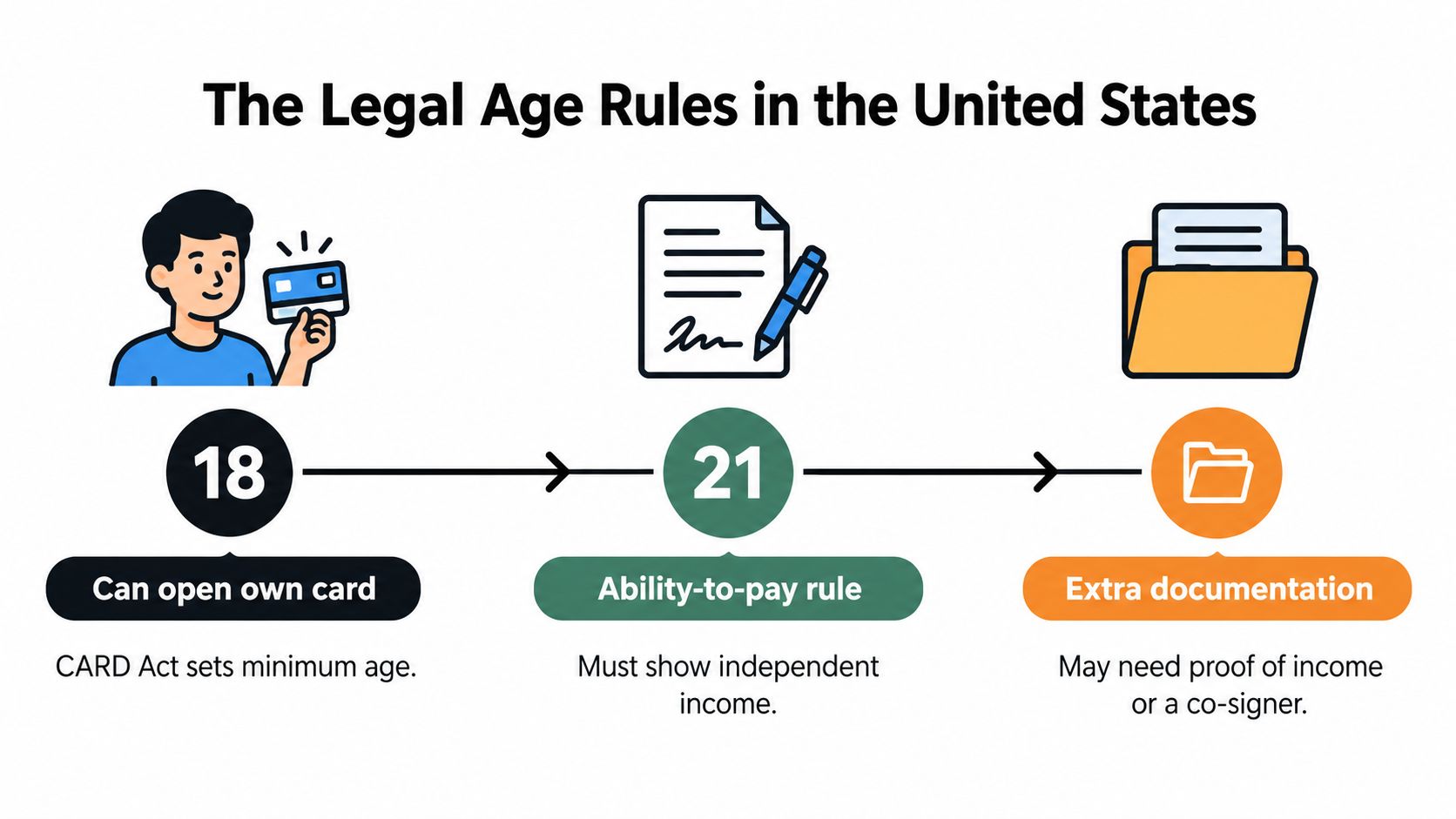
In the United States, 18 is when most people can apply for a credit card in their own name, while 21 removes the extra federal requirements for younger applicants to demonstrate independent repayment capacity or have an eligible adult share responsibility. Under 18, the practical path is being added as an authorized user by a parent or guardian.
Maybe your teenager has started asking for a card, or your first paycheck has you wondering whether it's time to apply. The useful next question isn't just whether a lender will let you borrow. It's whether you have a plan for paying the money back without squeezing groceries, rent, or savings.
Table of Contents
- Why the Question Is Bigger Than Age
- The Legal Age Rules in the United States
- The Four Ways a Young Person Can Hold a Card
- What Authorized-User Status Really Does
- Are You Actually Ready for a First Card
- Your First 90 Days With a New Card
- Common Myths That Lead Young Cardholders Astray
Why the Question Is Bigger Than Age
A high school student sees classmates tapping their phones to pay. A college freshman wants a card for everyday expenses. A parent hopes to help a teenager establish credit before leaving home.
They're asking similar questions, but they need different answers. Permission to apply, access to someone else's account, and readiness to manage debt aren't interchangeable. The Federal Reserve's explanation of the CARD Act distinguishes legal eligibility from the repayment assessment lenders must perform.
Separate permission from preparation
Think of legal eligibility as permission to enter a swimming pool. It doesn't tell you whether you can swim comfortably or what you'll do if you get tired.
Your credit decision needs separate checks:
- Legal eligibility: Can you apply independently, or would you need an authorized-user arrangement?
- Lender eligibility: Can you demonstrate repayment capacity and satisfy the issuer's application requirements?
- Budget readiness: Can you pay for planned purchases without relying on your next paycheck arriving exactly on time?
The lender answers the application question. You need to answer the household-budget question.
Practical rule: Don't ask a credit limit to solve a gap between your income and your essential expenses.
Resolve practical details before applying
Preparation also means knowing what information you'll submit. If your living arrangements are complicated, such as moving between college and home, clarify your address information rather than guessing.
For background on mailing and residential addresses, Cloud Residents' guide to using a PO box as a physical address can help you frame the questions to ask. Follow the card issuer's actual instructions when completing an application.
When can you have a credit card? The useful answer is a staged decision: choose the right account role, check the relevant rules, then test the payment against your budget. There's no prize for reaching the application stage before your finances are ready.
The Legal Age Rules in the United States
Being old enough to apply isn't the same as qualifying. Under the federal ability-to-pay rules, issuers assess income or assets alongside current obligations, and applicants aged 18–20 generally need independent repayment capacity or an eligible cosigner, guarantor, or joint applicant aged 21 or older who accepts legal responsibility.
That assessment concerns the required minimum payments. Your personal spending plan should set a more cautious standard than being able to meet the lender's minimum.
The age milestones are shown below. Read the independent-income requirement as a younger-applicant rule, not a new restriction that begins at the later milestone.
What independent repayment capacity means
Consider a student with a part-time job and no previous borrowing history. The relevant question isn't whether the student works. It's whether the income or qualifying assets can support payments after existing obligations.
Someone without negative credit history can still be declined if they can't demonstrate that capacity. Conversely, wages, self-employment earnings, or qualifying assets may support an application, subject to the issuer's review.
Before applying, organize information the issuer may request:
- Income records: Gather relevant pay statements or self-employment records.
- Asset information: Identify assets the issuer permits you to include.
- Existing obligations: List payments you're already responsible for.
- Application instructions: Check exactly what the issuer accepts rather than assuming every source of money qualifies.
These are preparation steps, not a promise that every lender asks for identical documents.
What changes after the younger-applicant stage
The special independent-capacity or eligible-adult requirement eventually ends, but ordinary affordability checks don't disappear. A birthday doesn't erase existing debt, establish reliable earnings, or guarantee approval.
A cosigner also isn't merely a reference who vouches for your character. They accept responsibility for the debt, so the conversation needs to cover what happens if you can't pay.
The same younger-applicant safeguards apply when requesting a credit-limit increase. Don't treat a larger limit as an automatic next step after opening an account.
The Four Ways a Young Person Can Hold a Card
The card's label matters less than your role and responsibilities. An authorized user participates in someone else's account, while a primary applicant asks a lender to approve an account in their own name.
Student and secured cards are product categories, not exemptions from the application rules. Compare their actual terms rather than assuming a beginner-focused name makes a card suitable.
Comparing the four ways to hold a credit card at a young age
| Path | Typical minimum age | Key approval signals | Main trade-off | Best fit |
|---|---|---|---|---|
| Authorized user | Issuer-specific; a minor may qualify | Primary cardholder permission and issuer policy | Less independence and exposure to the primary account's management | Supervised access |
| Student card applicant | Independent-application age rules apply | Repayment capacity and provider-specific student requirements | Student branding doesn't guarantee approval or favorable terms | Students comparing suitable entry-level options |
| Secured card applicant | Independent-application age rules apply | Issuer eligibility requirements and deposit terms | Money committed to a deposit isn't available for everyday needs | Applicants considering a structured starting option |
| Standard unsecured primary cardholder | Independent-application age rules apply | Income, obligations, credit information, and issuer standards | Access to borrowing still requires a firm spending boundary | Applicants ready to manage their own account |
Use this comparison to narrow your search, not to predict approval. The lender's current eligibility page and agreement should settle product-specific questions.
Choose terms before rewards
For a secured product, investigate the deposit amount, refund conditions, fees, and reporting practices before committing money. Morgan & Morgan Attorneys at Law P.C.’s discussion of secured credit cards for building credit offers additional reading for evaluating that route.
Don't use emergency savings as a deposit if doing so would leave you dependent on borrowing for ordinary surprises. A product designed for starting out still has to fit your cash flow.
For students, compare affordability and account terms before introductory perks. A card that looks appealing on an application page may be a poor fit if its costs or repayment demands don't suit your income.
Check the country as well as the product
These legal details aren't universal. In the United Kingdom, 18 is the standard minimum application age, but lenders also assess factors such as residency, income, identity, and credit history, as explained in Lloyds Bank's credit-card application guidance.
If you live outside the United States, begin with local issuer requirements. Don't carry a rule from another country into your application.
What Authorized-User Status Really Does
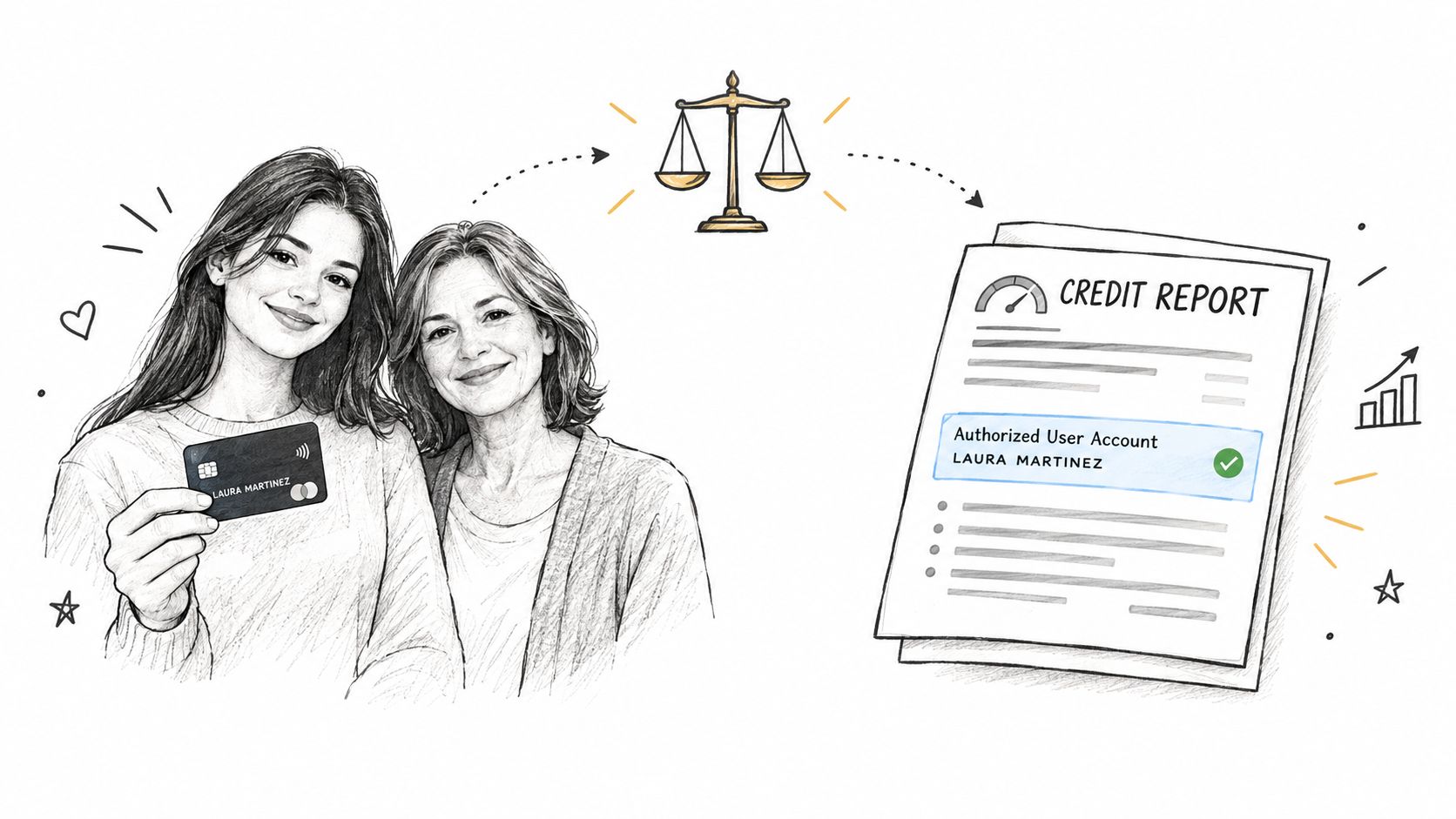
A card with a teenager's name on it can look like financial independence. Authorized-user status isn't the same as owning the underlying account, however, and the credit-building outcome depends on the issuer's reporting practices.
The family relationship is only part of the decision. The account's management and the issuer's policies matter too.
Two hypothetical families with different outcomes
In a hypothetical household, a parent adds a teenager after confirming that the issuer reports activity for users of the teenager's age. The parent keeps balances manageable, pays reliably, and reviews purchases with the teenager.
That arrangement may support a developing credit profile while providing supervised practice. The useful habit is the discussion before and after spending, not handing over a card.
In another hypothetical household, a parent adds a teenager without checking reporting rules. The parent later carries high balances and misses payments, creating the possibility that unfavorable account information affects the teenager's credit profile.
Bankrate's authorized-user guide explains that issuer minimum ages and reporting policies vary, including whether activity is reported before 18. It also addresses the risk that the primary cardholder's behavior can affect the authorized user.
A parent's good intentions don't substitute for checking the account's reporting rules.
Questions to ask before adding a teenager
Contact the issuer and ask specific questions rather than relying on a general promise about building credit.
- Age policy: Is my child eligible to become an authorized user?
- Reporting policy: Will you report this user's activity at their current age, and to which credit bureaus?
- Account information: What information will appear on the authorized user's credit file?
- Spending controls: What limits, alerts, or card-access controls can we use?
- Removal process: How can we remove the user, and how is that change handled in reporting?
Keep a record of the answers and review the arrangement if the primary account's finances change. If the parent is struggling to manage the existing balance, supervised spending practice without adding the teenager may be the more cautious choice.
The arrangement should teach judgment, not transfer financial uncertainty from parent to child.
Are You Actually Ready for a First Card
Try this exercise before opening an application: place a pretend card purchase into your current budget. If you can't identify the money that will repay it, you haven't found room for the purchase.
A zero-based budget gives available money a job before you spend it. A card changes the payment method, not the amount you can afford.
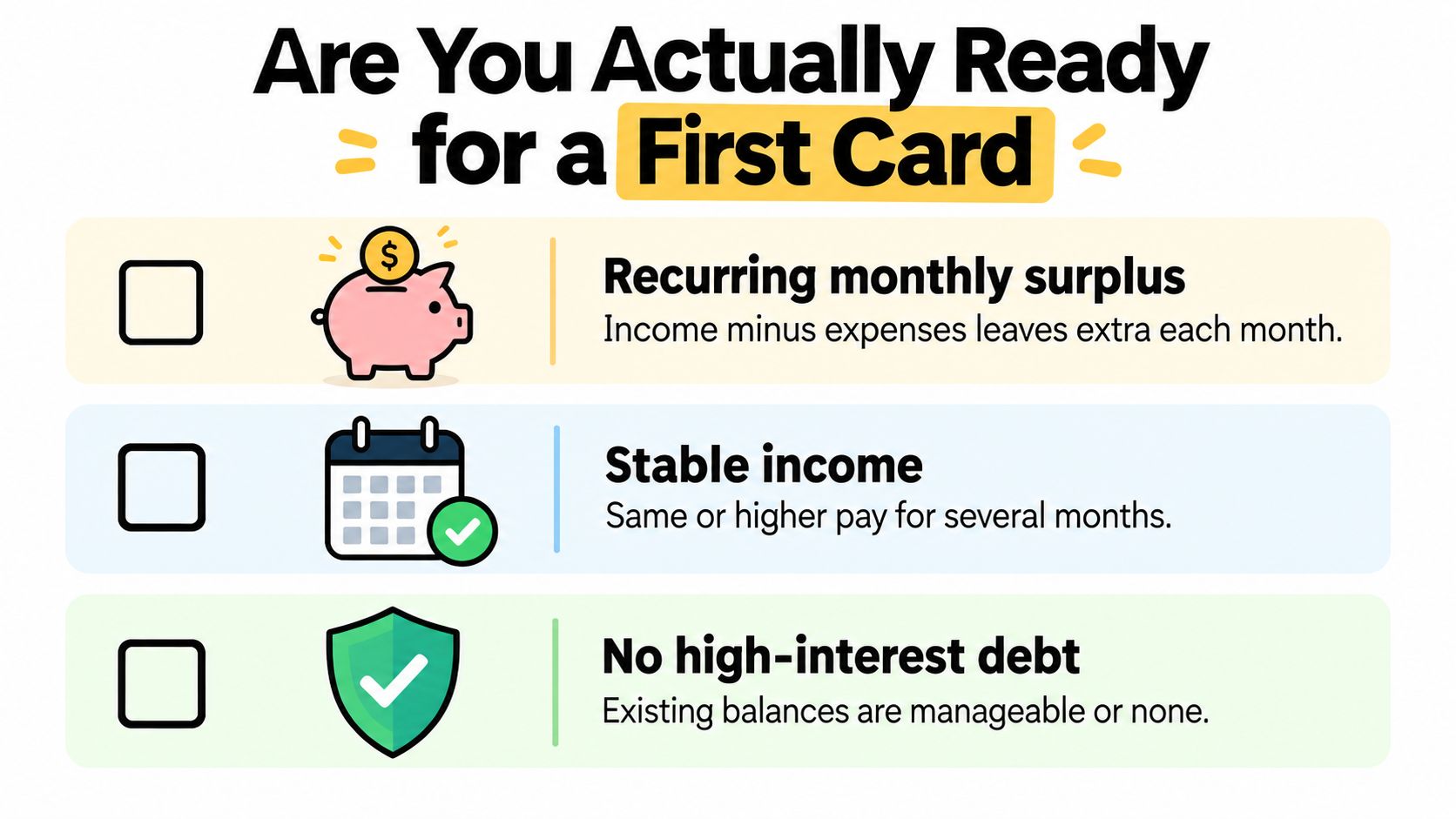
Use the checklist as a conversation starter, then examine the cash behind each answer.
Check the money before the payment method
Look for a recurring surplus. After essentials, existing obligations, and planned savings, you should have room for the spending you intend to put on the card. My recommendation is to assign repayment money when you make the purchase, not when the bill arrives.
For irregular income, build the plan around money you've received rather than optimistic expectations. A freelance invoice you hope to collect isn't the same as cash available for repayment.
Protect an emergency buffer. Decide what unexpected expense would otherwise push you into debt, then work toward a cash cushion that fits your circumstances. Don't count unused credit as that cushion.
Plan full-statement payment. Before your first purchase, decide which account will fund the payment and how you'll verify that the money remains available. Automation should support a funded plan, not disguise an unfunded one.
Make waiting an intentional decision
If these checks expose a shortfall, waiting is a useful financial choice. You can review subscriptions, adjust categories, and test a sustainable spending plan before introducing borrowing.
A student budgeting app guide can help you consider how to organize that review without treating another financial tool as the solution by itself.
When you're ready to explore products, use an eligibility checker or soft-search process where available rather than making several full applications in quick succession. HSBC's eligibility guidance separates basic eligibility from the lender's assessment of an application.
If your household is rebuilding after serious debt, LifeBack Law Firm, P.A.’s guide on how to build credit post-bankruptcy provides a separate starting point for that situation. Rebuilding deserves its own plan, not pressure to follow someone else's timeline.
Your First 90 Days With a New Card
Treat the first 90 days as a practice period, not a spending challenge. The following routine is a suggested plan, not a legal requirement or a promise about credit-score changes.
Use the timeline as a reminder to connect purchases, statements, and payments.
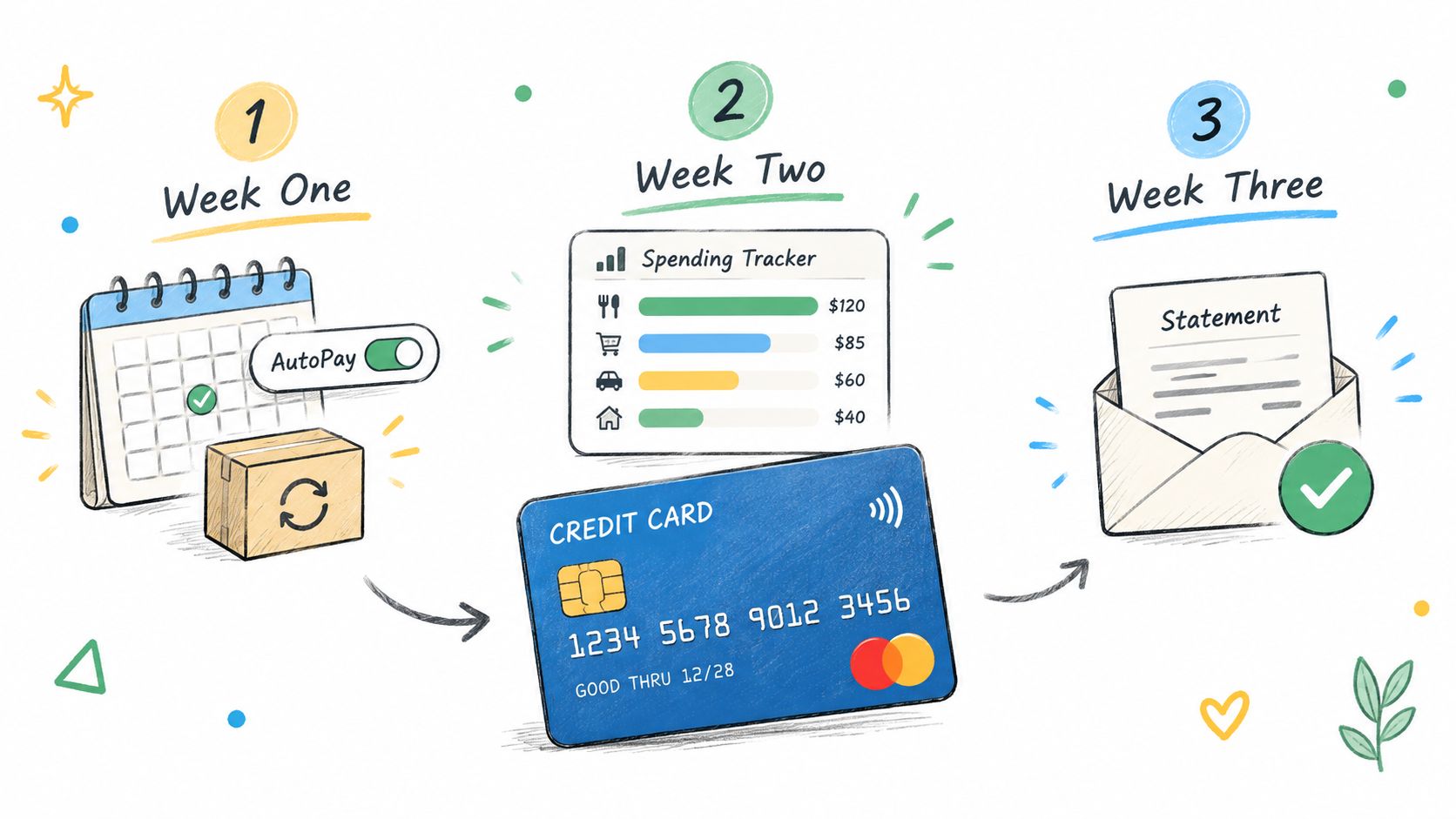
Start with a deliberately narrow purpose
Choose a small, predictable expense that already has a budget category. Avoid moving all your spending onto the card while you're still learning the account.
Set up statement-payment automation, confirm the due date, and enable useful account alerts. Then verify that the setup worked rather than assuming the first payment will happen correctly.
- Purchase check: Confirm the category has money available before charging.
- Balance check: Keep your own spending ceiling comfortably below the issuer's limit.
- Payment check: Match the statement to your records and confirm the scheduled payment has sufficient funding.
For utilization, use a conservative personal target rather than an unsupported universal percentage. Your practical ceiling should come from the amount you can repay, even when the issuer permits much more borrowing.
For an additional viewing resource, use the video below alongside your own card agreement.
Review the routine before expanding it
As statements arrive, compare your plan with your behavior. Did you buy things you wouldn't have bought with money already in your checking account? Did you need to move money away from essentials to cover the payment?
If either happened, reduce the card's role while you adjust the budget. You don't need another account or a higher limit to make this practice period worthwhile.
If you want to review credit information, compare credit-monitoring options similar to Credit Karma. Use monitoring to notice and investigate information, not to turn every score movement into an instruction to apply for more credit.
Common Myths That Lead Young Cardholders Astray
Approval means I can afford the card
Approval reflects the lender's decision under its rules. It doesn't establish that your preferred spending fits alongside your personal goals.
Your own test should include saving, predictable household costs, and room for uncertainty. Passing an application isn't permission to ignore those commitments.
Any payment card does the same job
Don't assume a debit card and a credit card produce identical credit-reporting outcomes. If building credit is your objective, verify what the particular account reports rather than judging it by the card's appearance.
The practical comparison also includes control over spending and comfort with borrowing. A cash-versus-credit-card comparison can help you think through which payment method supports your habits.
A small payment mistake doesn't need attention
Don't dismiss a missed payment because the amount seems minor or the delay feels brief. Check your agreement, contact the issuer, and resolve the problem rather than guessing about fees, reporting, or consequences.
Automatic payments deserve supervision too. Review the funding account and payment confirmation so that automation remains a safeguard rather than an assumption.
Before you borrow: Know what you'll buy, where the repayment money sits, and what you'll do if your income changes.
A first card should fit an existing plan. If you're not there yet, strengthening that plan is progress, not falling behind.
Peaceful Mindful Pocket LLC offers a zero-based budgeting app that helps you give every dollar a job and compare planned spending with actual transactions. Visit Peaceful Mindful Pocket LLC to organize your income, create clear spending categories, and test whether a first credit card fits your budget before you apply.