Your paycheck lands on the same days each month. Rent is steady. Insurance is steady. The streaming services, phone bill, and car payment barely move. You sit down with a notebook or spreadsheet and think, “I just want a plan I can stick to.”
That's the moment many people are really asking about when they search whether static budgets are often used by certain households or teams. They don't just want a textbook definition. They want to know who this method fits, when it helps, and when it starts to feel frustrating.
A static budget is one of those ideas that sounds formal, but the everyday version is simple. You pick your expected income or activity level at the start of the month, quarter, or year. Then you assign fixed amounts to categories and keep those targets in place while the period runs. If life goes roughly as expected, it feels calm and easy to follow.
That's why it appeals to beginners, couples trying to steady their spending, small departments with spending limits, and small businesses with fairly predictable patterns. It can also work as a “home base” even when your full money system includes something more detailed. If you want a broader look at planning before choosing a method, the Toya AI budget planning method gives a useful overview of how people turn rough intentions into a workable budget.
Table of Contents
- Introduction to Static Budgets and Who Uses Them
- What a Static Budget Is and How It Works
- Key Traits That Make Static Budgets Useful
- Static Budgets Compared With Flexible and Zero Based Options
- Real World Examples of Who Uses Static Budgets Most
- When to Keep a Static Budget and When to Switch
- Making the Right Budget Choice for Your Goals
Introduction to Static Budgets and Who Uses Them
A static budget usually makes the most sense for someone whose financial life has a lot of repeat patterns.
Think of a household where one or two salaries arrive on schedule, rent is fixed, utilities stay within a narrow band, and savings goals are clear. In that setting, it's natural to decide ahead of time that groceries get one amount, transportation gets another, and entertainment gets a cap that won't change unless the next budget period starts.
That same logic shows up outside the home. A school department may receive a spending limit and manage inside it. A small office may set annual payroll, rent, and software costs and use those figures as the reference point all year. A simple service business may do something similar when customer demand stays close to plan.
A static budget works best when the main question is, “Did we stay close to the plan we set?”
People often get confused because “fixed” sounds like “rigid forever.” That's not what it means. It means the plan stays fixed during the budget period. You can still make a new budget next month or next quarter. You're just not rewriting the targets every time something small changes.
The more stable your world is, the more useful this can feel. The more irregular your income is, the more likely you'll need a different approach for at least part of your budget.
What a Static Budget Is and How It Works
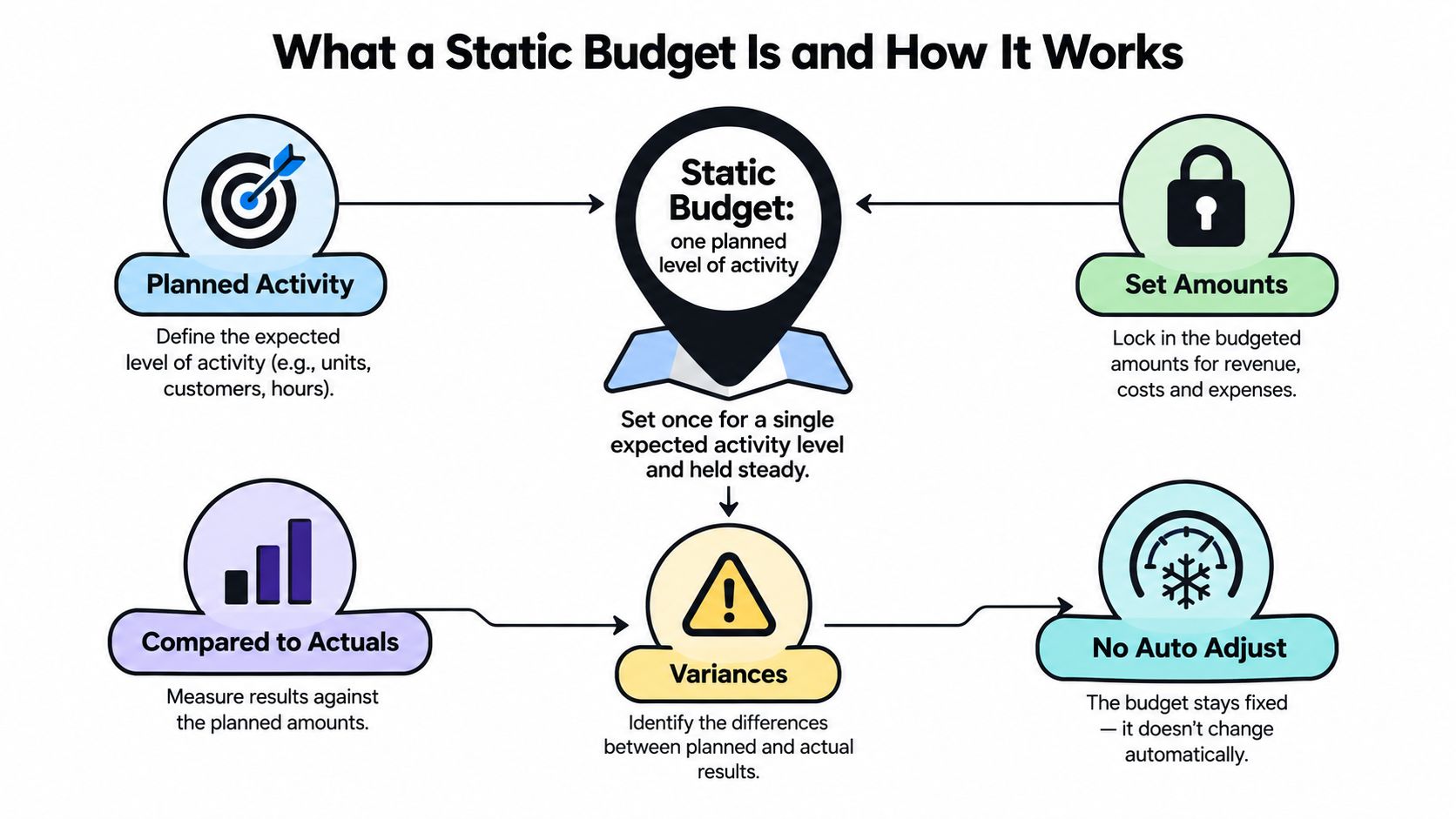
A static budget is built for one planned level of activity and then held in place for the period. Historically, this style of budgeting grew out of early management accounting practices. By the 1920s, firms were already setting cost standards and comparing actual spending against predetermined targets, a pattern that later evolved into what we now describe as static budgets, as explained in this overview of static vs flexible budgets.
Think of it like a road map
A static budget is like planning a road trip with one route before you leave.
You decide where you're going, how much gas you expect to use, where you'll stop, and what the total trip should cost. Once the trip starts, that map doesn't redraw itself just because traffic gets worse or you take a detour. It stays as the original plan. Then, at the end, you compare what happened to what you expected.
That's the heart of a static budget. You decide your target first. Then you compare later.
What stays fixed
Here's the simple sequence:
Pick one expected level
A household might budget based on its normal monthly take-home pay. A business might budget based on expected sales for the year.Assign target amounts
Rent, payroll, groceries, marketing, insurance, supplies, and savings all get planned amounts.Leave those targets unchanged
During the period, the budget itself doesn't flex automatically.Compare actual results to the plan
At the end of the month or quarter, you review the gap between the budget and reality.
That final gap is what accountants call a static-budget variance. You don't need the term to use the system well. Just think of it as the difference between “what we planned” and “what happened.”
Practical rule: A static budget answers one clean question. “How far did real life drift from the original plan?”
Why beginners often like it
Beginners usually don't struggle with the idea of planning. They struggle with too many moving parts.
A static budget removes some of that mental clutter. You aren't constantly recalculating category targets. You aren't adjusting every line item each time your spending shifts. You just make the plan, follow it, and review the differences.
That simplicity is why static budgets are often used by people who want clarity more than constant optimization. It gives you one stable reference point.
A common misunderstanding is that a static budget is “wrong” whenever life changes. That isn't quite right. The budget is still doing its job as a baseline. It's showing you where reality departed from your assumption. The problem only comes when the changes are so frequent that the baseline stops being useful for decision-making.
Key Traits That Make Static Budgets Useful
Static budgets remain common because they're straightforward. AccountingTools describes the static budget as the simplest budgeting format and notes that it's commonly used as the base against which actual results are compared in this explanation of static budgets.
Why many people start here
For a beginner, simplicity isn't a small benefit. It's the whole game.
A budget that's easy to read has a better chance of being used. If a couple can look at the plan and quickly see the category caps, they're more likely to stay engaged. If a department manager knows the spending ceiling, accountability is clearer. If a small business owner wants one annual target to track against, a static budget gives that target cleanly.
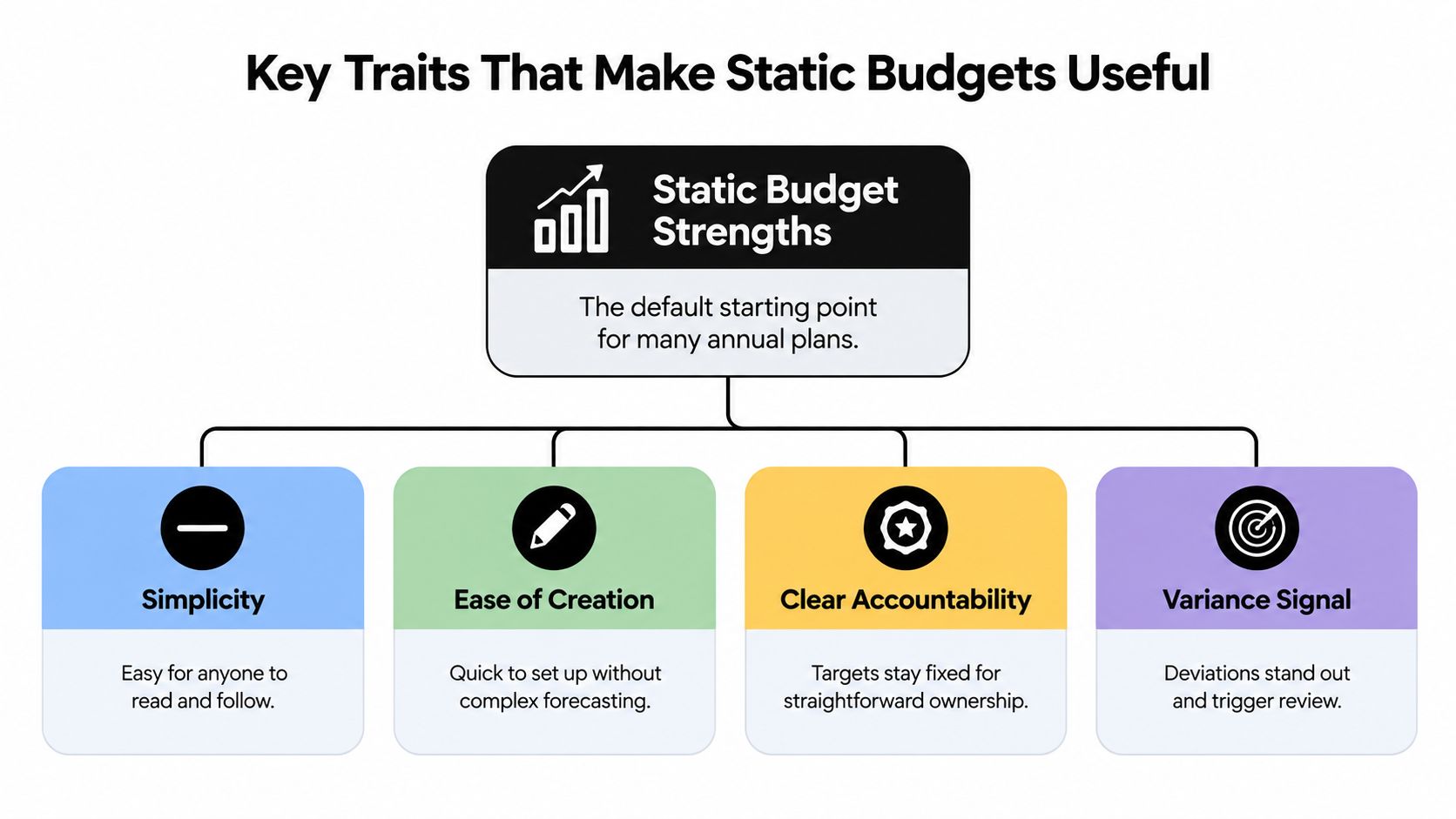
A few traits make static budgets especially useful:
Simple structure
You set the amounts once. That makes the plan easier to explain to a spouse, a team member, or a department lead.Easy setup
You don't need a complicated model to begin. That's one reason annual plans often start here.Clear accountability
Since the target doesn't keep moving, it's easier to ask whether someone stayed within the agreed limit.Visible variance signals
If actual spending comes in above or below plan, the difference stands out fast.
Where they fit best
Static budgets work best when activity levels are relatively stable and when management wants a simple tool for planning and review. Accounting education materials also note they're especially useful when expenses are largely fixed or output stays close to budget, while they become less informative when volume shifts a lot, as discussed in this management accounting resource.
That's why this method pairs naturally with categories like rent, insurance, and payroll. Those are the same kinds of expenses many people think of as fixed costs. If you want a beginner-friendly explanation of that idea, this guide on what fixed expenses are is helpful.
Static budgets are strongest when repeat costs dominate the plan and the real world stays reasonably close to the forecast.
Where people get tripped up is assuming a useful variance always means poor performance. Sometimes a variance means activity changed. If a business sold more than expected, some costs may rise too. The fixed budget still shows a difference, but that difference may say more about changed volume than about waste.
Static Budgets Compared With Flexible and Zero Based Options
A static budget isn't the only way to budget, and it doesn't need to be. Many people get better results by understanding what each method is trying to do.
A flexible budget adjusts expectations when activity changes. A zero-based budget starts by giving each dollar a specific job. These approaches solve different problems.
The basic trade-off
A static budget is easiest when you want one stable target.
A flexible budget is stronger when income, sales, or workload keeps changing. It updates the expectation so your comparison stays fairer.
A zero-based budget is useful when your main problem isn't activity swings but fuzzy spending decisions. It forces intentional choices category by category.
| Budget Type | How It Handles Change | Best For | Limitation |
|---|---|---|---|
| Static | Stays fixed during the period | Stable households, fixed-cost departments, predictable small businesses | Can make performance look worse or better when volume changes |
| Flexible | Adjusts targets as activity changes | Seasonal work, changing sales, irregular operating volume | Takes more tracking and judgment |
| Zero Based | Reassigns money by purpose from the ground up | People who want strong control over every dollar | Can feel more hands-on and time-consuming |
Why many people mix methods
This isn't an either-or choice for everyone.
Some households use a static cap for rent, insurance, and childcare but use zero-based planning for groceries, fun money, and savings goals. Some small businesses use a static annual budget for overhead and a more flexible review process for categories tied to changing demand.
If you're still building your overall system, this guide on how to create a budget can help you choose the structure before you choose the method.
There's also a broader behavior shift worth noticing. In 2025, Bank of America reported that 16% of respondents used zero-based budgeting, 19% used cash stuffing, 19% used the 50/30/20 rule, and 26% used pay-yourself-first. TD's 2025 survey also found that 78% of people use some resource to keep up with their budget and 17% use a budgeting app, based on the Bank of America 2025 budgeting findings.
That mix tells us something important. People aren't waiting for one perfect system. They're combining methods that match real life.
Real World Examples of Who Uses Static Budgets Most
The best way to answer who benefits most is to stop talking in accounting language and start talking about actual lives.

Households with repeat patterns
A family with steady paychecks often does well with a static budget.
They know the mortgage or rent. They know the car payment. They know the insurance premium. Even if groceries and power bills move a little, the overall month has a familiar shape. In that case, the budget acts like guardrails. It tells the family what “normal” should look like.
This is one reason static budgets are often used by couples who are trying to calm money arguments. A fixed plan reduces debates about what each category should be this week. The amount was already agreed on.
Families who want a broader planning framework often also benefit from guidance on financial planning for families, especially when they're balancing bills, goals, and shared decisions.
Teams and small operations with capped costs
A static budget also fits small departments and simple businesses.
Think about a local office with fixed rent, regular payroll, recurring software charges, and basic operating supplies. Or a nonprofit program that has to stay within a clear spending ceiling. In those settings, the point isn't to redesign the budget every week. The point is to control spending and review any category that drifts from plan.
A short monthly review works well here:
Check big fixed categories first
Did rent, payroll, or insurance match the planned amount?Look for preventable drift
Were office supplies, subscriptions, or contractor costs higher than expected?Decide whether the issue was behavior or changed activity
That question keeps the review fair.
Here's a simple visual walkthrough that can help this click for beginners:
Where a static budget starts to fail
Now the hard truth. A purely static budget often frustrates freelancers, contractors, commission earners, and households with irregular income.
If your income changes from month to month, a fixed plan can start feeling like a bad snapshot. You may set a careful budget at the start of the month, then lose confidence in it as soon as a client pays late or a slow sales week hits. The issue isn't that you lacked discipline. The issue is that your baseline assumption moved.
For irregular income, static budgets still help with fixed bills. They just shouldn't carry the whole system by themselves.
That's where a hybrid workflow makes sense. Keep static caps for predictable categories like housing, insurance, and core subscriptions. Then use a more adjustable method for groceries, owner pay, irregular business expenses, and extra debt payments. That gives you both structure and room to adapt.
When to Keep a Static Budget and When to Switch
Sometimes a static budget is doing exactly what you need. Sometimes it's making your reviews less useful.
The trick is knowing the difference.
Signs to keep it
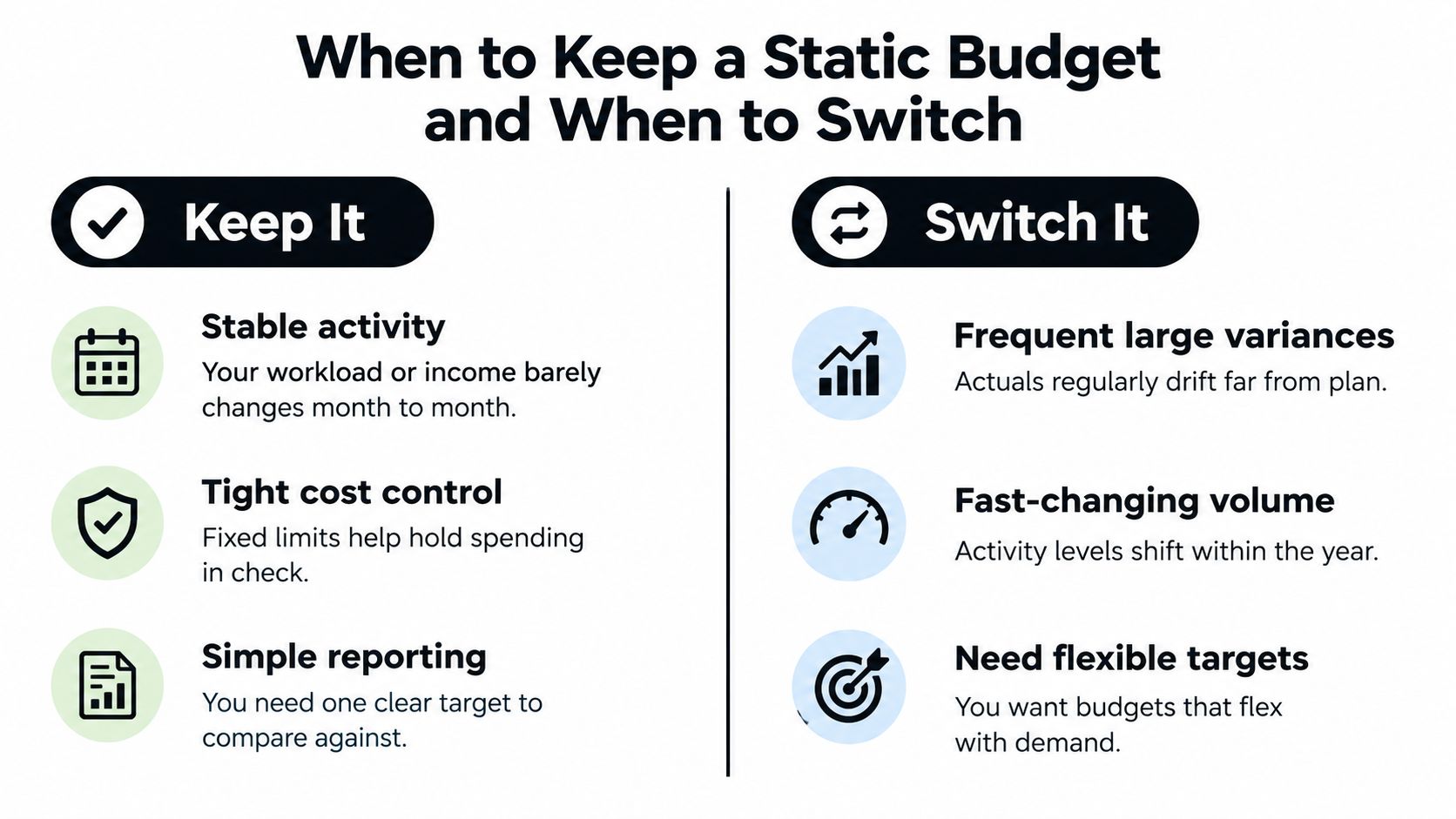
Keep a static budget if your money life or operation stays fairly steady and the budget still helps you make good decisions.
A few green lights:
Income or workload barely moves
Your plan still reflects the month you live.Most major costs are fixed
Housing, payroll, insurance, subscriptions, or contracted services dominate the budget.Monthly review feels clear
When you compare actuals to plan, the differences tell you something useful.You need one simple target
This matters for beginners, spouses sharing a plan, and managers with spending responsibility.
Signs it's time to switch or layer another method
Trouble shows up when the same categories keep missing the target for reasons that aren't really under your control.
Watch for these patterns:
Frequent large variances
If actual results keep drifting far from plan, your original assumption may no longer be the right baseline.Changing sales or income volume
A business with uneven demand or a worker with irregular income may need targets that move with reality.Constant mid-month rewriting
If you keep informally changing the budget anyway, a different method would probably fit better.Confusing performance reviews
If you can't tell whether a miss came from overspending or changed activity, the budget is losing diagnostic value.
Monthly check: Ask, “Did this budget help me understand what happened, or did it just show that life changed?”
A practical hybrid option
You don't have to throw the whole method out.
Many people do better with a layered setup:
Keep static limits for fixed categories
Rent, insurance, debt minimums, payroll, and annual subscriptions fit well here.Use flexible thinking for variable categories
Groceries, fuel, materials, part-time labor, and seasonal spending may need room to move.Use zero-based planning for intention
This is especially helpful when extra income arrives and you want to assign it on purpose.
That blend gives you a stable base without pretending every month is identical.
Making the Right Budget Choice for Your Goals
Static budgets are often used by people and teams who value clarity, consistency, and spending control over constant recalculation. That includes households with steady income, departments with fixed limits, and small businesses with repeatable cost patterns.
They're less comfortable for anyone living on uneven cash flow. If your income changes often, or your workload swings from one month to the next, a static budget can still help with core bills. It just shouldn't be the only lens you use.
The simplest way to decide is to ask three questions:
- Is my income or activity level stable enough for one fixed plan to stay useful?
- Do most of my important costs stay the same from period to period?
- When I compare plan to reality, do I learn something actionable?
If the answer is mostly yes, a static budget may be a strong fit.
If the answer is mostly no, don't force it. Use a hybrid. Keep fixed caps where they help. Add flexible adjustments where life won't sit still. Add zero-based planning where you need sharper intention.
Good budgeting doesn't come from choosing the most official-sounding method. It comes from choosing a system you can understand, maintain, and trust when real life happens.
Peaceful Mindful Pocket LLC helps individuals and families turn rough money goals into clear category-based plans, especially when they want more control than a simple spreadsheet gives them. If you want support building a zero-based system that can work alongside fixed categories and real transaction tracking, visit Peaceful Mindful Pocket LLC.