You opened the store-card app, the credit-card app, and the personal-loan portal in the same sitting. Three balances, three due dates, and one spare amount you can actually send: $300 on top of $245 in minimums, so the monthly budget is $545. A snowball debt payoff calculator turns that pile into a dated order instead of a guess.
It will not pretend the easiest habit and the cheapest math are the same thing. A quick first payoff can cost extra interest. A timeline that looks fastest on a screen can also fail if it empties checking and pushes you back onto a card the month income drops.
Table of Contents
- How the Debt Snowball Works in Plain Terms
- Inputs the Calculator Needs and Why Each One Matters
- Monthly Payments and the Full Three-Debt Schedule
- Snowball Versus Avalanche on the Same Debts
- Turning Calculator Results Into a Zero-Based Budget
- Run Your Own Numbers and Commit to an Order
How the Debt Snowball Works in Plain Terms
Say those three debts are yours. The store card is $850 at 29.99%, minimum $35. The credit card is $2,400 at 22%, minimum $70. The personal loan is $5,600 at 11%, minimum $140. You are not unusual for juggling more than one balance. The New York Fed's household debt report put U.S. household debt at $18.39 trillion at the end of the second quarter of 2025, with credit-card balances at $1.21 trillion beside much larger mortgage, auto, and student totals.
Picture a small snowball at the top of a hill. The first loop is light. Each loop you finish sticks to the ball, so the next loop hits harder. Debt works the same way when you follow three rules.
List balances smallest to largest, and ignore the rate while you sort. Pay at least the minimum on every account so nothing falls behind. Send every spare dollar to the smallest balance until that account is gone, then aim the whole freed payment at the next one.
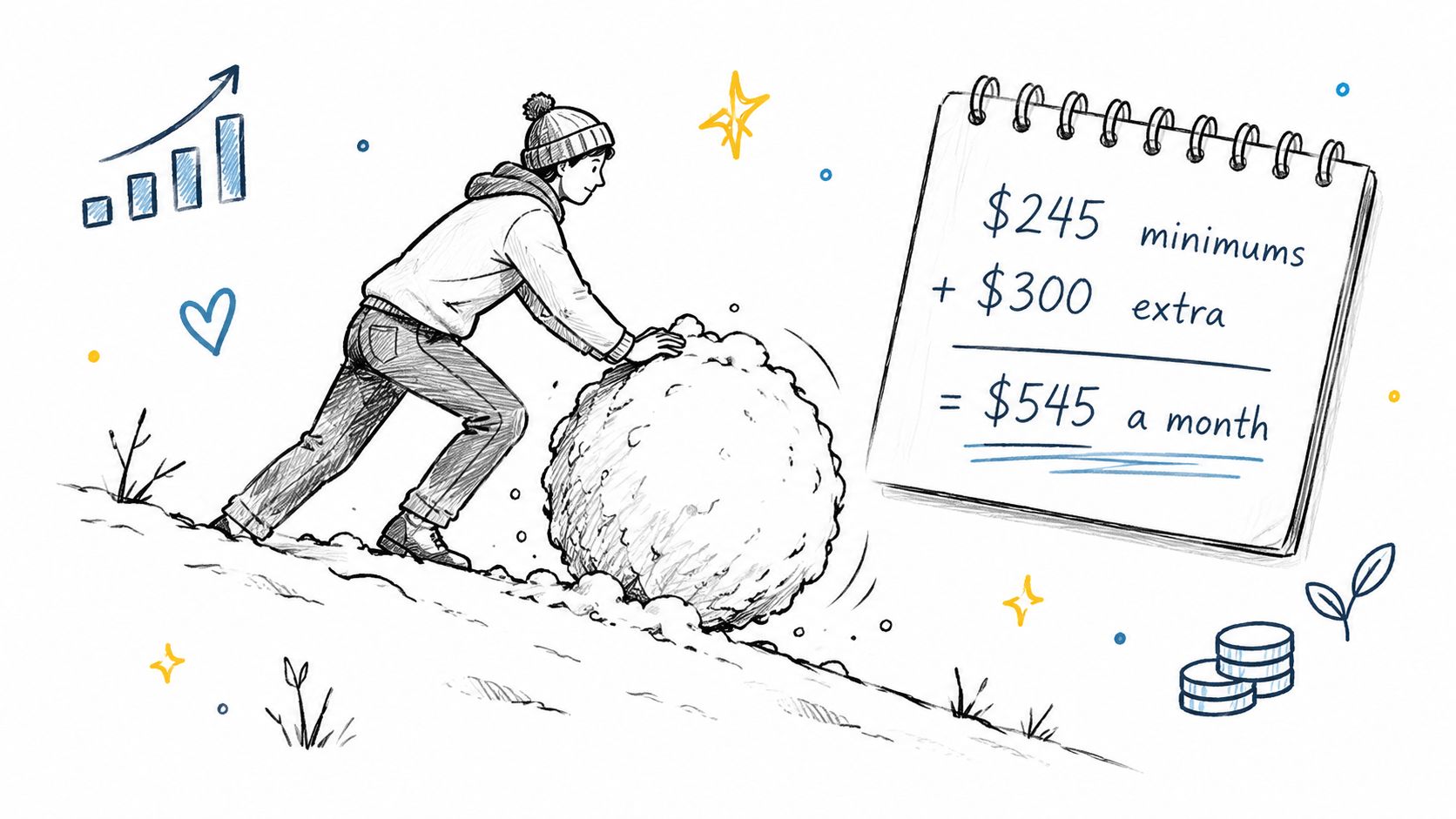
On this $545 budget, the calculator's answer is concrete. The store card closes in month 3. The credit card closes in month 9. The loan closes in month 18. Total interest lands near $960. The month-by-month proof comes next.
A useful snowball debt payoff calculator should show more than one finish date. You want the payoff date, total interest, accounts closed by month, the number of payments, and a snowball-versus-avalanche comparison on the same inputs.
| Debt | Snowball order | Paid off in month |
|---|---|---|
| Store card, $850 at 29.99% | 1st | Month 3 |
| Credit card, $2,400 at 22% | 2nd | Month 9 |
| Personal loan, $5,600 at 11% | 3rd | Month 18 |
| All three debts | Full sequence, smallest to largest | Month 18 |
Inputs the Calculator Needs and Why Each One Matters
A calculator is only as honest as the account-level numbers you type. Seven inputs drive this example. Miss one and the month-18 finish date is a story, not a plan.
| Input | What to enter | How it changes the result | Example value |
|---|---|---|---|
| Balance | Current amount owed from the latest statement | Sets the snowball order, smallest first | $850, $2,400, and $5,600 |
| APR | Annual percentage rate on the statement | Sets monthly interest as APR divided by 12 | 29.99%, 22%, and 11% |
| Minimum payment | Contractual minimum due each month | Must be paid on every account before any extra | $35, $70, and $140 |
| Due date and billing cycle | Day the payment is due and when interest posts | Sets the timing of interest and late-fee risk | 15th of each month |
| Recurring fees | Annual or monthly account fees | Added to the balance and to total cost | $0 in this example |
| Extra monthly amount | Money above all minimums you can commit every month | Speeds every closure and shortens the timeline | $300 |
| Cash floor | Amount you keep in checking and do not send to debt | Protects against new borrowing after an income dip | $500 |
Balance is what sets the line. The $850 store card goes first even though someone might rather attack the loan. APR becomes monthly interest when you divide by 12. That is why $850 at 29.99% costs $21.24 in the first month, before a dollar of payment lands. Minimums are not optional extras. All $245 goes out before the $300 may move.
The two inputs people mistype
APR from memory is the first miss. A rate you remember as "about 20%" can be 22% or 29.99% on the statement. Use the statement figure, not a rounded guess from last year.
The extra amount is the second miss. People type their best month. A freelance month that once cleared $700 does not belong in a plan you must repeat. Use the lowest typical surplus you can keep, which is $300 here.
The order ignores rate on purpose. A small low-rate balance can sit in front of a larger high-rate one. That is the behavior of the method, not a software bug.
Flag this: if a payment does not cover that month's interest, the balance grows. A trustworthy calculator should mark that account instead of drawing a shrinking chart.
The 15th is the due date in this run, so interest and late-fee risk share one calendar day. The $500 cash floor never enters the $545. It stays in checking so a thin week does not become a new charge.
Monthly Payments and the Full Three-Debt Schedule
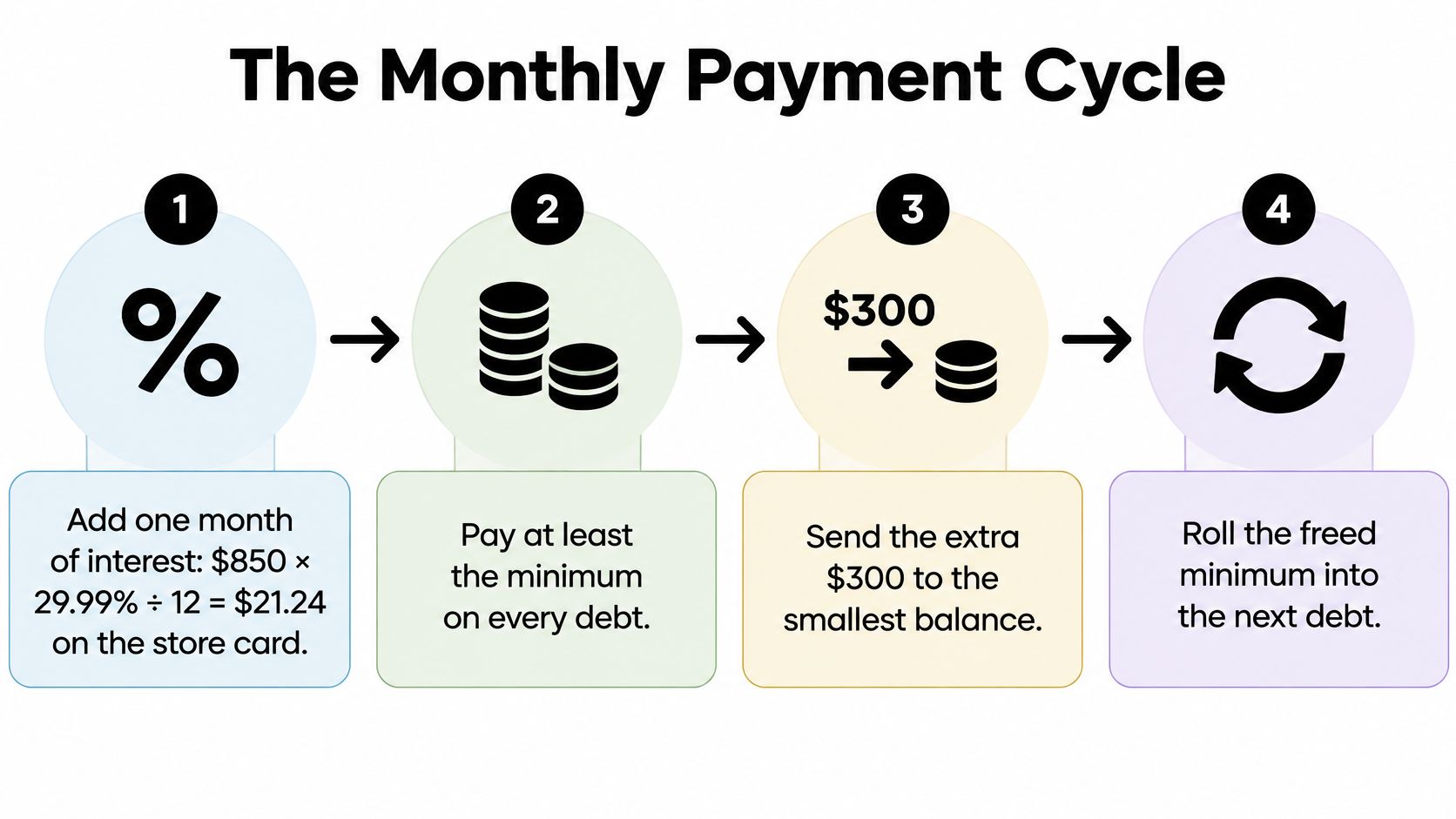
Each month is the same four moves. The dollars change. The order does not.
Four steps every month
- Add one month of interest to each open balance. On the store card, $850 × 29.99% ÷ 12 = $21.24.
- Pay at least the minimum on every debt that is still open.
- Send every leftover dollar to the smallest balance. In month 1 the store card gets $335 ($35 plus the $300 extra). The credit card gets $70. The loan gets $140. Those three payments add to $545.
- Roll the freed payment forward when a balance hits zero. In month 3 the store card only needs $220.00. The leftover $115 joins the credit card's $70, so that card receives $185.
Skip the roll and the model pretends you suddenly spend the freed minimum on something else. The CFPB's reducing-debt worksheet describes this same handoff. Early closes create visible progress, and they can also raise total cost while a higher-rate balance is still open. The calculator should also flag any payment that does not cover accrued interest, because that balance grows.
This run assumes fixed APRs, interest added once a month, no new charges, on-time payments, and the full $545 used every month. Fees are zero. Change any of those and the months move.
The month-by-month balances
| Month | Store card (payment / balance) | Credit card (payment / balance) | Personal loan (payment / balance) |
|---|---|---|---|
| 1 | $335 / $536.24 | $70 / $2,374.00 | $140 / $5,511.33 |
| 2 | $335 / $214.64 | $70 / $2,347.52 | $140 / $5,421.85 |
| 3 | $220.00 / Closed | $185 / $2,205.56 | $140 / $5,331.55 |
| 4 | Closed | $405 / $1,841.00 | $140 / $5,240.42 |
| 9 | Closed | $320.43 / Closed | $224.57 / $4,687.52 |
| 18 | Closed | Closed | $543.99 / Closed |
Walk the store card first. After month 1 it sits at $536.24. After month 2 it sits at $214.64. Month 3 interest is $5.36, so the payoff amount is $220.00, and the account closes.
From month 4 the credit card receives $405: its own $70, the retired $35, and the $300 extra. It closes in month 9 on a $320.43 payoff. The unused $84.57 plus the loan's $140 means the loan receives $224.57 that month.
From month 10 the loan receives the full $545. It closes in month 18 on a $543.99 payment. A dollar or two may remain as rounding. It does not open a 19th month.
Check the totals before you trust the date
Eighteen months at $545 is $9,810 paid. Principal is $8,850 ($850 + $2,400 + $5,600). The gap is about $960 of interest. Each row's payments still add to $545, except the final month, where the loan takes $543.99 and the budget has a small remainder.
If you want a different timeline, change only the total budget and run it again. Don't edit one balance by hand and leave the others stale.
That check is the habit. If the payments in a row don't match the budget, the snowball wasn't rolled, and the debt-free month is too late.
Snowball Versus Avalanche on the Same Debts
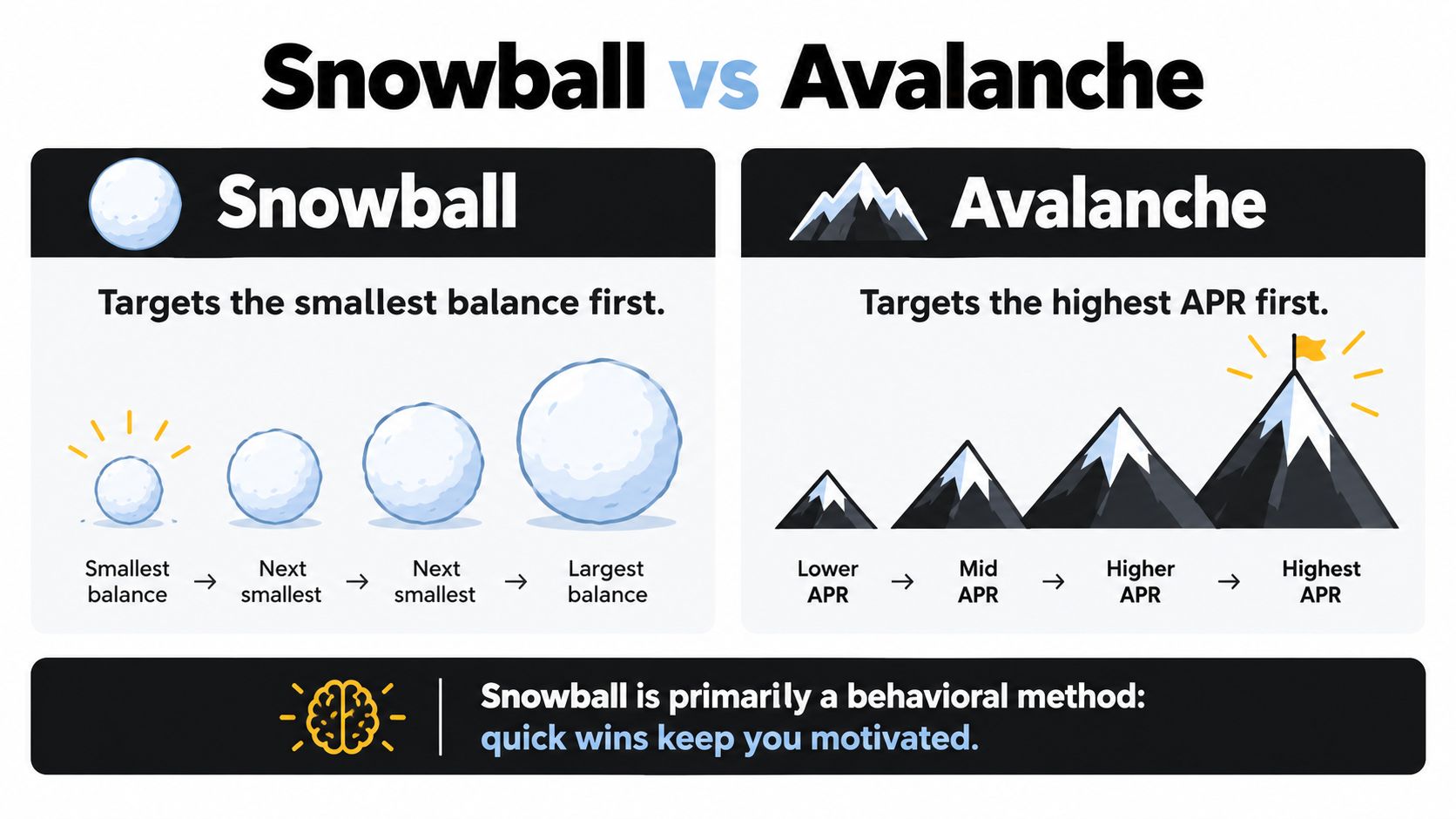
Snowball aims at the smallest balance. Avalanche aims at the highest APR. Avalanche generally costs less interest when the monthly budget and every other input stay the same. Snowball is the method that buys earlier account closures.
On the first three debts, both orders start with the store card. It is the smallest balance and the highest rate, so they don't split yet. The split shows up as soon as the small balance is not the expensive one.
Where the two orders split
Take a second pair and a $300 budget: a $600 loan at 9% with a $25 minimum, and a $3,000 card at 26% with a $75 minimum, so the extra is $200. Snowball clears the loan first. Avalanche clears the card first. Run on those minimums, snowball interest is about $593 and avalanche interest is about $508. The quick win costs about $85.
A single finish date hides that price. RightCapital's debt-management notes pull in a sharper comparison. A 2023 study found snowball users made 143 total payments versus 202 under avalanche, because closing accounts sooner can help people stick with the plan. A 2025 analysis found snowball produced just over 84% of avalanche's interest savings, while an optimized-payment approach reached nearly 93%.
| Factor | Snowball | Avalanche |
|---|---|---|
| Target order | Smallest balance first | Highest APR first |
| First debt closed | Usually the smallest, often sooner | Usually the highest-rate debt, can take longer |
| Interest cost | Higher, a premium over rate-first repayment | Generally lowest when all other inputs match |
| Payments needed in one 2023 study | 143 | 202 |
| Interest savings captured in a 2025 analysis | Just over 84% of avalanche savings | 100% benchmark |
| Best fit | Motivation is the main risk | Discipline is strong and the rate gap is large |
Put three numbers on one screen: interest cost, month each account closes, and payment actions. The $85 gap is the price of the first win in the second case. The fewer payment actions are the reason some people finish at all.
Which order to commit to
Choose snowball when quitting is the biggest risk and you need a closed account within a few months. Choose avalanche when you will still pay in month 10 and the rate gap is wide, as 9% versus 26% is. Choose a blend when one small balance can die quickly and you then switch every extra dollar to the highest rate.
The same ordering question shows up on installment debt. If one of your balances is a car note, the quickest way to pay off a car loan walks through how extra principal changes that single account. Neither order wins for every household.
Turning Calculator Results Into a Zero-Based Budget
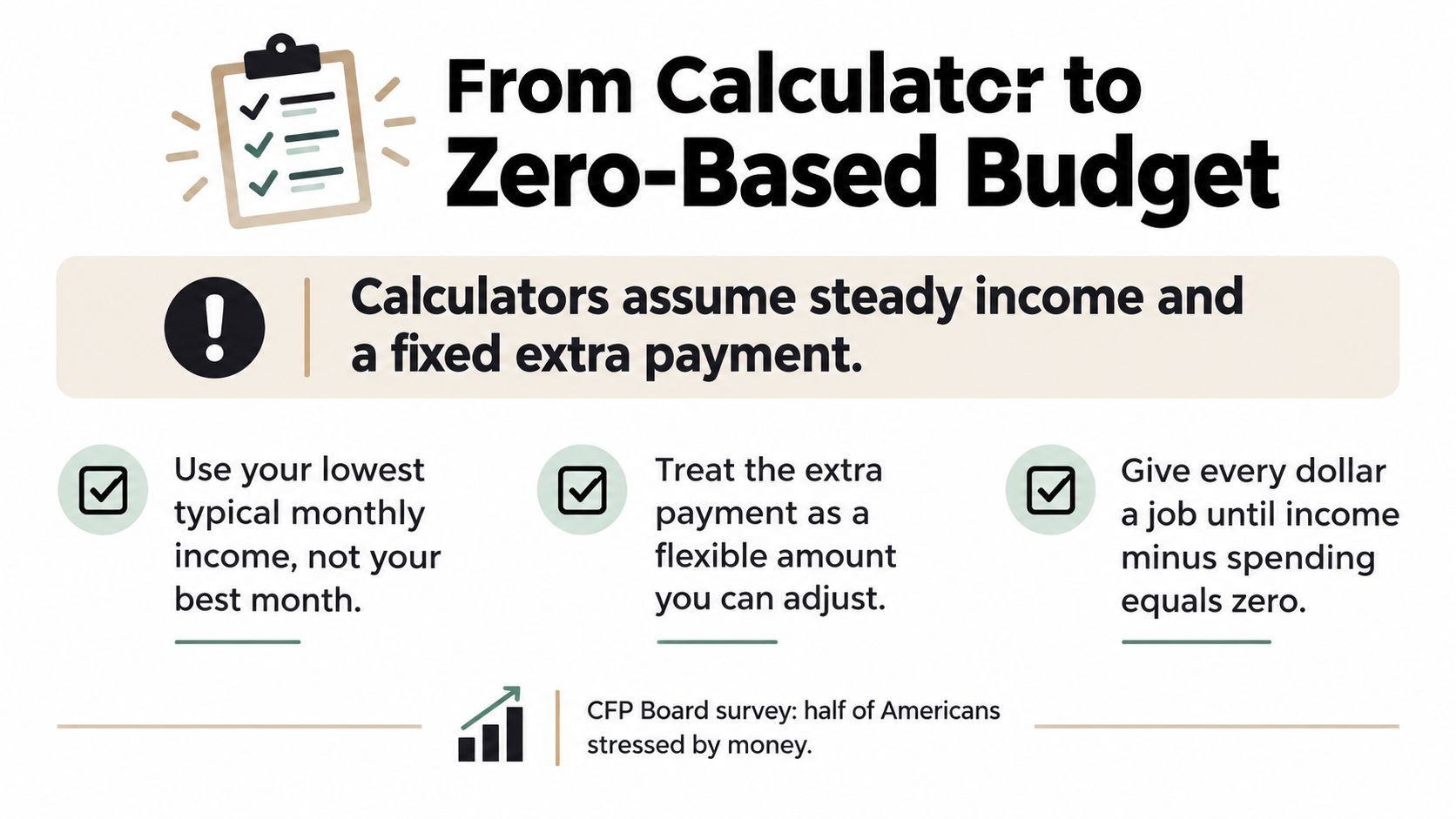
Most calculators assume the same paycheck and the same extra payment every month. A lot of households don't live that way. Freelance months swing. A bill lands early. The prettiest 18-month chart becomes fragile if it leaves checking at zero.
A CFP Board survey, summarized in Vanguard's research on saving and debt paydown, reported that half of Americans stressed by excessive credit-card debt regularly make only minimum payments, and 46% struggle to limit card use. A plan that only works on your best month will fall back to those minimums the first time pay dips.
Four income situations
| Income situation | Extra payment rule | Action when a debt closes |
|---|---|---|
| Steady salary | Fixed extra amount every month, set after the cash floor | Reassign the closed debt's full payment the same month |
| Irregular or freelance income | Extra set from the lowest typical month's surplus | Keep the reassigned payment in the plan, not in spending |
| One-time windfall such as a bonus or refund | Apply only after minimums and the cash floor are covered | Send to the smallest open balance as a one-time payment |
| Income drop | Pause extra payments and keep all minimums | Re-run the calculator before resuming extra payments |
A zero-based budget gives every dollar a job until income minus the plan equals zero. The debt payment is one job. The cash floor is another. They are not the same pile.
- Steady pay: lock the extra after the floor is funded, then leave it alone.
- Irregular pay: build the extra from the low month. A strong month can be a one-time extra, not the new normal.
- A windfall: fund minimums and the floor first. Only then send the rest to the smallest open balance.
- A pay cut: extra payments stop first. Minimums stay. Resume the extra only after you run the numbers again.
Put the freed payment on paper the same day
When an account closes, move its old payment to the next debt in that same budget session. Waiting until "next month" is how $35 drifts into spending.
- Keep the floor as its own category so it isn't accidental leftover cash.
- Label recurring extra money apart from one-time money. A quarterly client check is not a monthly $300.
- Re-run the calculator each quarter, and sooner if pay changes.
- Watch for payoff progress followed by new borrowing. That loop can wipe out the interest you thought you saved.
A worked zero-based budgeting example shows how named categories absorb a closed account without raising spending. Outside the budget, it also helps to build habits that prevent debt so the balances you're attacking aren't replaced by new ones. A zero-based budget app such as Peaceful Mindful Pocket lets you rename buckets, assign planned amounts, and keep a time-stamped ledger, so the reassigned payment is written down instead of assumed.
Run Your Own Numbers and Commit to an Order
You can finish a first pass in one sitting if the statements are already open.
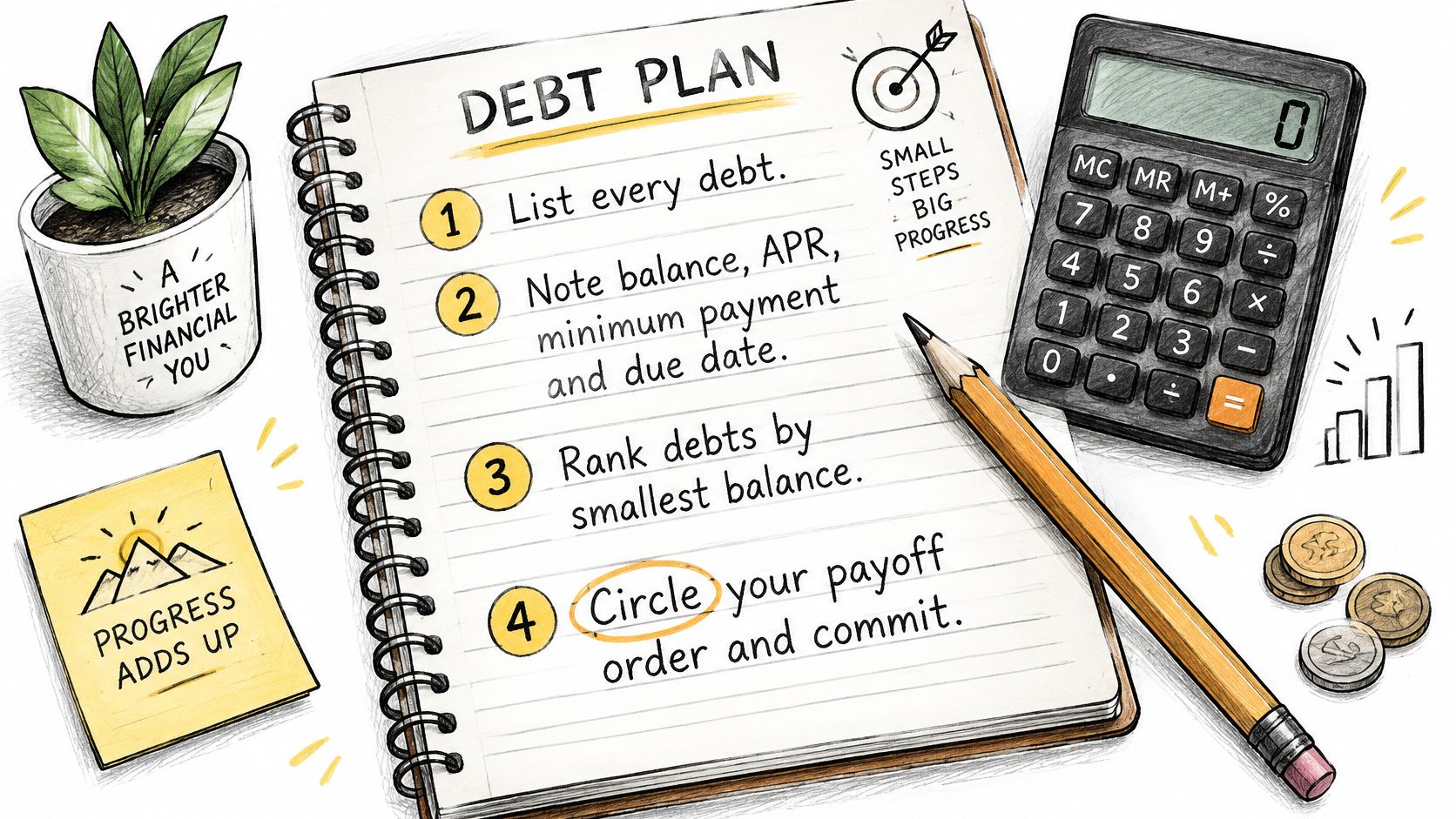
- List every debt with balance, APR, minimum, and due date from the latest statement.
- Sort by balance, smallest first, and write the APR beside each name so you can see where avalanche would disagree.
- Set a cash floor, such as one month of essential bills, and keep it out of the debt budget.
- Enter the lowest typical extra you can repeat, not your best month.
- Run the calculator and write down three numbers: debt-free date, total interest, and first closure month.
- Run avalanche on the same inputs and compare the interest gap with how soon the first account dies.
- Pick one order and assign a budget category to each debt at its planned amount. If you want a second opinion on a card balance, check your balance payoff schedule against the statement APR before you lock the category.
- Set a reminder to re-run the plan after each payday and after each debt closes.
Sticking with the categories matters as much as the sort order. A short guide on how to stick to a budget covers the weekly check that keeps the extra payment from slipping.
The short video below walks through a payoff order in plain language. Use it as a check on the list above, then go back to your own statement numbers.
Write the debt-free date and the first closure month where you will see them on payday. A budget app can hold those categories and the time-stamped changes in one place, so the order you picked is still the order you pay next month.
Peaceful Mindful Pocket LLC offers a zero-based budgeting app that helps you give every dollar a job, including the minimums, the extra payment, and a cash floor you refuse to spend. That is the practical side of a snowball debt payoff calculator: the month an account closes, you reassign the freed payment instead of losing it. Visit Peaceful Mindful Pocket LLC to start a demo budget and put your own payoff order into named categories.