In June 2025, buying a starter home cost an average of $908 more per month than renting across the 50 largest U.S. metropolitan areas, and renting was cheaper in 49 of those 50 markets according to Realtor.com's June 2025 rental analysis. That fact doesn't prove renting is always better. It shows why the question “is buying better than renting?” can't be answered by comparing a mortgage payment with rent alone.
Table of Contents
- Introduction to Buying versus Renting
- Understanding Key Decision Factors
- Calculating the Financial Break-Even Point
- Assessing Tax Benefits and Equity Growth
- Considering Lifestyle Mobility and Market Risk
- Applying Zero-Based Budgeting to Your Decision
- Use Cases and Practical Recommendations
Introduction to Buying versus Renting
Buying can create equity, provide control over the property, and reduce exposure to future rent increases. Renting can preserve cash, support mobility, and protect a household from property-price declines and unexpected ownership costs. The stronger choice depends on how long you expect to stay, how much cash you can commit, how stable your income is, and what your local market looks like.
A sound comparison should include the down payment, financing costs, taxes, insurance, maintenance, purchase and selling costs, and the investment return you could have earned on the cash tied up in the property. It should also test whether a lower long-term cost would leave you short of emergency savings today.
Housing norms differ widely across countries, so international context matters. Readers comparing markets can also review this practical guide to rent vs buy in Australia, where local prices, taxes, lending rules, and lifestyle considerations shape the calculation differently.
This article uses two decision tools together. A break-even timeline estimates when ownership may overtake renting financially. Zero-based budgeting tests whether either option fits your real monthly cash flow without crowding out savings, flexibility, or essential spending.
Understanding Key Decision Factors
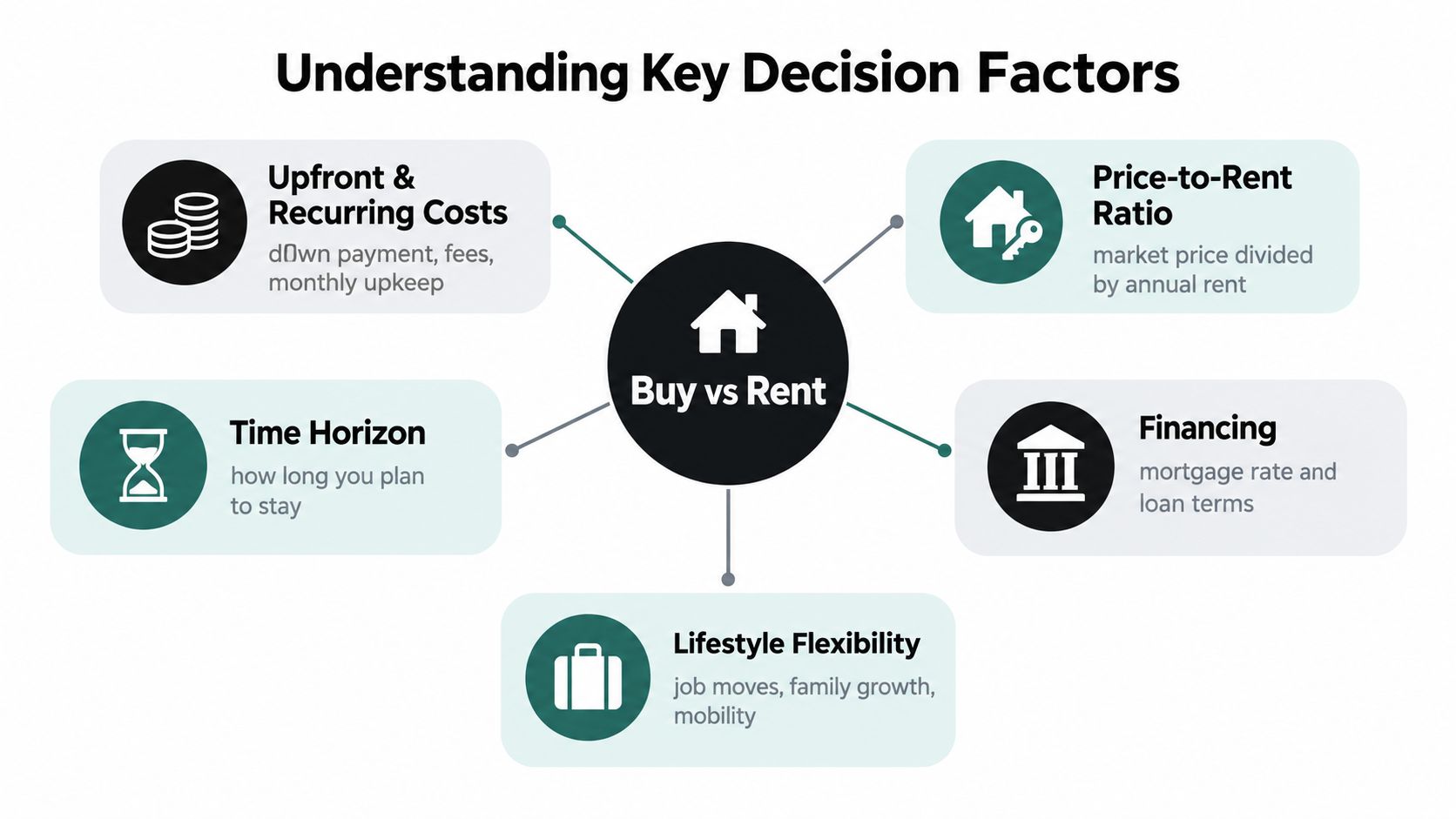
The decision rests on five connected questions rather than one payment comparison.
- Upfront and recurring costs: Buying requires capital before the first payment begins, then adds mortgage interest, taxes, insurance, maintenance, and eventual selling costs. Renting usually requires less initial cash and shifts many repair obligations to the property owner.
- Price-to-rent conditions: A high property price relative to local rent makes ownership harder to justify through cash flow alone. A lower ratio can support buying, but it doesn't remove financing, maintenance, or resale risk.
- Time horizon: Acquisition and disposal costs need time to be absorbed. A household expecting a short stay faces a different calculation from one planning to remain for many years.
- Financing: Borrowing costs, loan terms, and the size of the down payment affect both monthly affordability and the speed at which equity develops.
- Lifestyle flexibility: A renter can usually respond more easily to a job move, changing family needs, or uncertain income. An owner gains control but may face repair bills and a costly exit.
Country-level housing patterns reinforce the need for context. Across OECD countries in 2022, 71% of households either owned their homes outright or were paying a mortgage, while 24% rented in private or subsidized markets, according to the OECD housing analysis. Those figures reflect history, policy, prices, and cultural preferences, not proof that ownership delivers a better result for every household.
A useful preliminary exercise is to determine the rent your income can support before comparing it with purchase prices. A rental income required calculator can help frame that affordability question, but it shouldn't replace a full budget or a local ownership-cost model.
The key insight is that the factors interact. A buyer with stable income and a long horizon may accept weak initial cash flow because equity accumulation matters. A freelancer may value liquidity so highly that renting remains sensible even if ownership appears cheaper on paper.
Calculating the Financial Break-Even Point
A break-even calculation asks when the buyer's cumulative financial position becomes stronger than the renter's. It isn't a prediction. It's a structured comparison of assumptions that should be tested under several outcomes.
Start with the buyer's total cost:
Mortgage principal and interest + property taxes + insurance + maintenance + financing fees + purchase costs + selling costs − ending equity.
Then calculate the renter's position:
Total rent paid + the opportunity cost of the down payment + the opportunity cost of monthly savings that could have been invested.
The buyer's ending equity includes the property's value minus the remaining loan balance and selling expenses. The renter's ending wealth includes the invested down payment and any invested difference between rent and ownership cash flow. Comparing these two positions at several holding periods produces a break-even timeline.
Build scenarios instead of relying on one forecast
The verified market evidence points to the importance of this distinction. In Q2 2025, renting was financially cheaper than owning in all 50 largest U.S. markets when recurring housing costs alone were compared, but ownership produced net gains in 14 markets after potential appreciation and equity were included, according to First American's market analysis.
That result separates cash-flow affordability from wealth creation. A household can choose the cheaper monthly option while still accepting lower potential long-term wealth, or choose the more expensive option because it expects to stay long enough for equity to matter.
Use three cases rather than one optimistic estimate:
| Scenario | Appreciation Rate | Break-Even Horizon |
|---|---|---|
| Conservative | Enter your cautious assumption | Calculate from total costs and equity |
| Expected | Enter your central assumption | Calculate from total costs and equity |
| Adverse | Assume weak or no appreciation | Calculate from total costs and equity |
The table intentionally leaves the rate and horizon for the household to supply. No universal appreciation rate can describe every city or holding period. A Cleveland Federal Reserve review estimated an average nominal single-family-home return of 9.8% annually from 1986 to 2014, but it also found substantial variation between metropolitan areas and showed that longer historical comparisons can produce different conclusions. See the Cleveland Fed review of homeownership returns for the evidence and limitations.
Practical rule: If buying only wins under the optimistic scenario, treat the purchase as a lifestyle choice with financial upside, not as a certain investment.
Run the model again if your expected tenure changes, your income becomes irregular, borrowing conditions shift, or local insurance and tax costs rise. The most useful answer isn't “buy” or “rent.” It's the point at which your assumptions make one option financially stronger, and how much downside you can tolerate before that conclusion reverses.
Assessing Tax Benefits and Equity Growth
Ownership creates several potential wealth channels, but each needs separate treatment. Amortization reduces the outstanding loan balance. Appreciation may raise the property's market value. Tax rules may reduce eligible costs, depending on the buyer's jurisdiction and personal tax position. These benefits shouldn't be combined into one vague “equity” estimate.
Mortgage interest deductions and property-tax treatment depend on local law, filing status, eligibility, and whether the household can use the deduction. A tax benefit has value only if it applies to the buyer and changes the tax bill. Model it as a separate annual line, then test the result without it so the purchase doesn't depend on a benefit that may be unavailable.
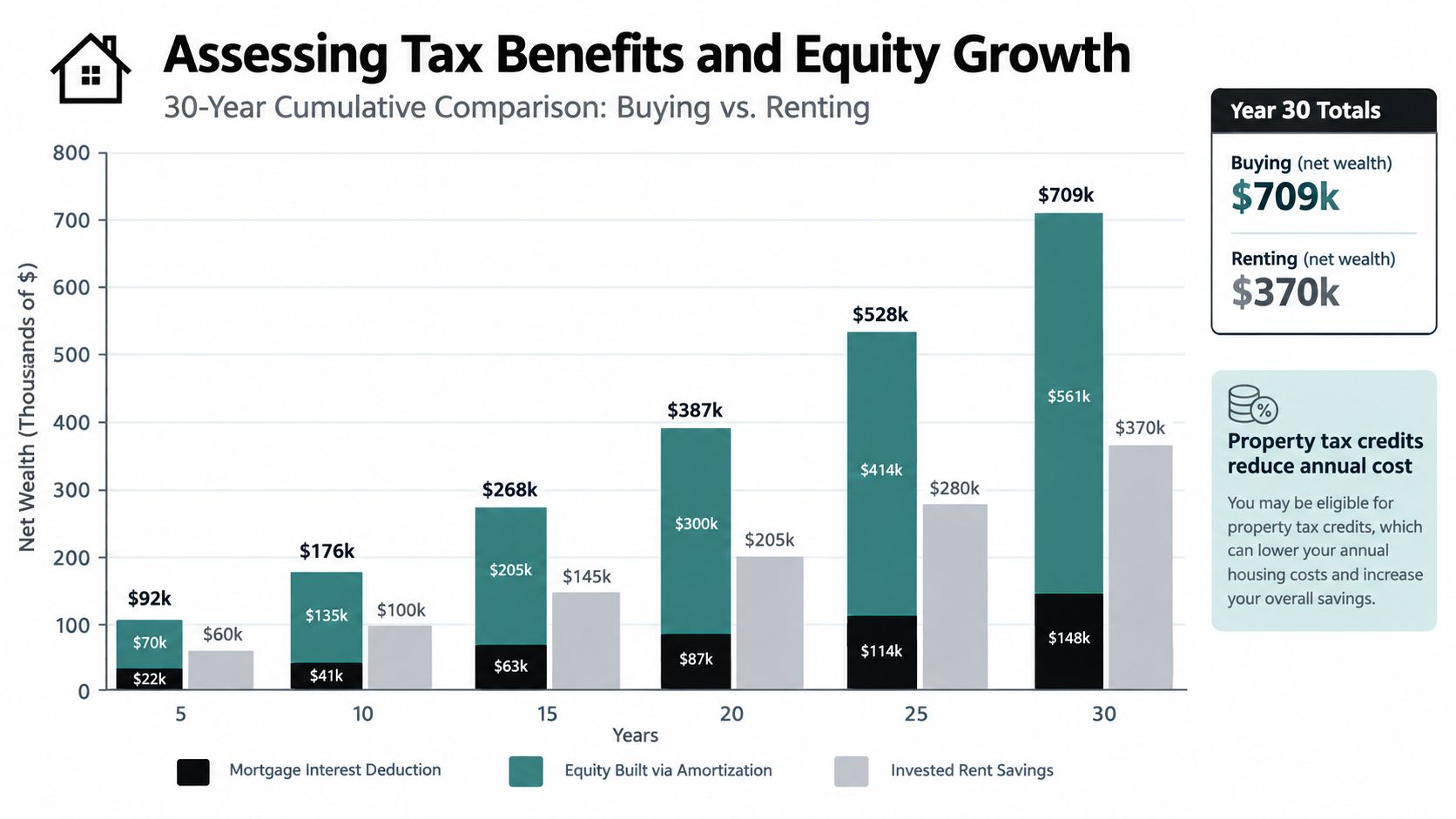
The Cleveland Fed's historical estimate of 9.8% average nominal annual returns for U.S. single-family homes from 1986 to 2014 doesn't establish a forward-looking return for a specific property. Returns varied by metropolitan area and depended on the holding period, while longer-run evidence in the same review indicates that housing and equities had comparable overall returns across a much longer history and that equities generally performed better after 1950, particularly after 1980.
Keep equity distinct from liquidity
A homeowner may have rising equity and still lack available cash. Equity can't pay an unexpected bill unless the owner sells, refinances, or borrows against the property. Each route can be slow, costly, or unsuitable during a downturn.
A renter who invests the down payment and monthly savings may build a liquid portfolio instead. That outcome requires discipline, consistent contributions, and tolerance for investment volatility. It also means rent isn't automatically “wasted.” Rent purchases housing services and preserves capital that could be deployed elsewhere.
Households considering accelerated loan repayment can examine the trade-offs in this guide on whether to pay off your mortgage. The central question remains the same: does directing extra cash toward home equity fit the household's liquidity needs and broader return expectations?
Considering Lifestyle Mobility and Market Risk
A lower projected lifetime cost doesn't automatically make buying the better decision. If a job move, relationship change, family expansion, or income disruption forces a sale, transaction costs and weak market conditions can overwhelm the expected advantage.
Renting has an option value. It lets a household change location without selling a physical asset, and it reduces direct exposure to local property prices. Buying provides control over the dwelling and may offer payment stability, but the owner carries repair obligations, market risk, and the financial consequences of leaving.
Income data reveal the tension. In 2022, U.S. renters paid a median of 32% of family income toward rent, nearly twice the comparable housing cost burden reported by homeowners, while 63% of renters cited the inability to afford a down payment as a reason for renting, according to the Federal Reserve's household well-being report.
That evidence doesn't mean buying solves affordability. It shows that renters can face substantial ongoing pressure while still lacking the capital required to enter ownership. A buyer who uses nearly all available savings for the down payment may replace rent pressure with liquidity risk.
Score the risks that payment calculators miss
Consider these profiles:
- Relocating employee: Renting may be stronger if a promotion or employer change could require a move.
- Growing family: Buying can offer control over space, but only if the property suits likely needs and the household can manage upkeep.
- Freelancer: Renting can protect cash reserves during uneven income periods, even when ownership costs appear manageable in strong months.
- Stable local worker: Buying becomes more defensible when employment, location, and expected tenure are all reliable.
The right comparison includes an exit plan. Ask how quickly the property could be sold, which costs would arise, and whether the household could continue making payments during a period without employment. If those answers are uncomfortable, flexibility may be worth more than projected appreciation.
Applying Zero-Based Budgeting to Your Decision
Zero-based budgeting turns the housing choice into a cash-flow test. Instead of asking whether a household can technically make the payment, assign every unit of take-home income to a purpose and check whether both options leave room for essential reserves and goals.
Start with actual take-home income
Use dependable net income, not an optimistic gross-income estimate. For a freelancer, use a cautious baseline derived from recurring work and keep irregular payments outside the core housing plan. A household with variable earnings should avoid making the mortgage affordable only in its strongest months.
Next, assign money to the full cost of living:
- Housing: Include rent or mortgage principal and interest, taxes, insurance, utilities, maintenance reserves, and fees.
- Protection: Fund emergency savings, insurance premiums, debt obligations, and irregular annual bills.
- Goals: Allocate money to retirement, education, investments, travel, or other priorities.
- Daily life: Cover food, transport, healthcare, childcare, and personal spending.
- Flexibility: Preserve a cash reserve for repairs, relocation, income gaps, or family changes.
For renting, add the planned investment of the down payment and monthly housing savings. For buying, add an explicit maintenance reserve and a separate allowance for transaction costs. Don't treat principal repayment as a pure expense, but don't treat it as liquid cash either.
Run a zero-based stress test
Create three budgets:
- Normal month: Use expected income and recurring expenses.
- Weak-income month: Reduce variable income and retain essential obligations.
- Ownership shock: Add a major repair, tax increase, insurance change, or temporary income interruption.
A budget passes when every version keeps essential spending funded without relying on credit or the immediate sale of the home. The monthly remainder doesn't need to be large, but it shouldn't be negative after realistic allocations.
A detailed guide to creating a budget can help organize the categories before you compare tenure options. Use the same categories for renting and buying so the model exposes the true difference rather than hiding ownership costs inside a single mortgage number.
The safest housing choice is the one that preserves both shelter and decision-making room when income or circumstances change.
Use Cases and Practical Recommendations
A young family with stable income, a long expected stay, and sufficient cash reserves may favor buying. The recommendation becomes stronger when the property can accommodate likely family needs and the break-even model still works under conservative assumptions.
A freelancer with irregular income should usually prioritize liquidity and flexibility. Renting may be preferable until income history, reserves, and the expected location become more stable. Buying can still work, but only if the zero-based stress test remains positive during weak-income periods.
An urban professional expecting a move should be cautious about purchasing for a short stay. Renting preserves the ability to accept a new role or relocate without selling an illiquid asset. A retiree seeking control and stability may favor ownership if ongoing taxes, insurance, maintenance, and accessible reserves fit the retirement budget.
First-time buyers who choose to proceed should investigate inspections, financing terms, ownership costs, and resale considerations before making an offer. This first-time buyer guidance from Corinthian Surveyors London offers a practical checklist for that preparation.
Recalculate whenever your expected tenure, income, financing, rent, insurance, or family needs change. The answer isn't a permanent identity. It's a decision that should continue to fit both your balance sheet and your life.
Peaceful Mindful Pocket LLC helps individuals, families, and freelancers assign every dollar a job with a zero-based budgeting app built for clear housing comparisons and stronger cash control. Visit Peaceful Mindful Pocket LLC to build a budget, test rent-versus-buy scenarios, and protect the reserves that keep your decision flexible.