You're standing at a grocery checkout with your wallet open. The bill is $54, and you're deciding whether to tap your card or peel off a few twenties. The purchase is already made in your head, but the payment method still has a say in what happens next.
That small choice affects more than convenience. It changes how clearly you feel the purchase, how easily you can track it, whether fees or rewards attach to it, and how much room you leave for the rest of the month. Cash and credit cards are budgeting tools, not merely competing ways to settle a bill.
There isn't one universal winner. Cash usually wins when spending control is the priority. A credit card wins when you pay the statement balance in full and value documentation, fraud protection, or rewards. The strongest system gives every dollar a job first, then chooses the payment method that protects that job.
Table of Contents
- The Register Moment That Quietly Shapes Your Budget
- How Americans Actually Pay in 2026
- Six Criteria to Compare Cash and Credit Cards
- Spending Psychology When You Swipe vs Hand Over Bills
- Fees, Interest, Fraud, and Chargebacks in Real Numbers
- Zero-Based Budgeting With Cash, Cards, or Both
- Which Payment Method Fits Your Money Goals
- Quick Answers About Mixing Cash and Credit
The Register Moment That Quietly Shapes Your Budget
At the register, the card offers speed. One tap, one approval, and the groceries go into the cart. Cash creates a pause. You count the bills, hand them over, receive change, and physically watch part of your spending money leave.
That pause matters most when the purchase belongs to a flexible category. Groceries, dining out, entertainment, and convenience purchases can expand until they absorb money intended for savings or debt payments. A card can make an affordable purchase feel harmless because the account balance changes later, while cash shows the limit immediately.
I've watched debt-payoff clients make the same mistake repeatedly. They created a reasonable grocery budget, paid with a rewards card, and reviewed the transactions only after the week was over. The problem wasn't the card itself. The problem was that the payment method gave them no immediate warning when several small extras pushed the category beyond its assignment.
Practical rule: Choose the payment method that makes your most dangerous spending habit harder.
A card may be the better tool for a recurring bill, an online purchase, or a merchant where dispute protection matters. Cash may be the better tool for a restaurant category that keeps running over budget. Your decision should also account for rewards. If you're comparing cards, a current resource such as this 2025 credit card cashback comparison can help you evaluate whether the reward structure fits spending you already planned.
The framework in this article comes down to three questions. Can you track the purchase tightly? Does the payment create fees, interest, or useful protection? Does it help you behave according to the budget you wrote?
A zero-based budget makes those questions concrete. Once income has been assigned across bills, spending, savings, and debt, the right payment rail is the one that keeps each assignment intact. Cash, credit, or a combination can work, but only when the method supports the plan instead of overriding it.
How Americans Actually Pay in 2026
The broader payment mix has moved sharply toward cards, but cash hasn't disappeared. The Federal Reserve's payment diary recorded credit card payments rising from 8 per month in 2016 to 15 per month in 2023, while cash payments fell from 14 to 7 per month over that period. The same Federal Reserve Diary of Consumer Payment Choice reports that in 2024, credit and debit cards together accounted for more than 60% of payments, with credit at 32%, debit at 30%, and cash at 14%.
Those figures describe a payment environment where card users need a card-compatible budgeting system. A paper envelope can still work, but card purchases need to be assigned promptly to the same categories. Otherwise, the budget becomes a collection of intentions while the checking account and card statement tell a different story.
The most recent diary data also show that payment behavior remains mixed. In the United States, consumers made 47 payments per month in 2026, including 16 by credit card, 15 by debit card, and 6 by cash, according to the 2026 Federal Reserve Diary of Consumer Payment Choice. The Fed describes cash as a backup payment option and a store of value, which is important for households that need resilience as well as convenience.
| Payment Method | 2016 Share | 2026 Share | Budgeting Implication |
|---|---|---|---|
| Credit card | 8 payments per month | 16 payments per month | Track purchases against categories before the statement arrives |
| Debit card | Not specified in the cited 2016 figure | 15 payments per month | Treat checking-account activity as part of the active budget |
| Cash | 14 payments per month | 6 payments per month | Use physical limits for categories where overspending is common |
| Other methods | Not specified | Remaining payments | Record each transaction so assigned dollars remain visible |
The cross-country evidence adds an important correction to the idea that cash is obsolete. Cash represented 46% to 82% of payment transactions across countries in one large comparison, yet in Canada, France, and the United States it represented only about one-fourth of transaction value. Cash can remain common for smaller purchases while cards handle more of the money spent, as described in the cross-country payment diary comparison.
Your budget should reflect that reality. Use cash where visibility and limits matter, and build fast transaction tracking for everything that runs through cards or bank accounts.
Six Criteria to Compare Cash and Credit Cards
A useful cash vs credit card comparison needs more than a list of advantages. Measure each method against the job you need it to perform.
Spending control
Cash usually wins. You can spend only what you carry, which creates a hard stop for an envelope category. A credit card can support disciplined spending, but it also makes it easy to commit future income before you've checked the budget.
Fees and interest
Cash wins when access is free, while a credit card wins only when you pay in full and avoid avoidable fees. Carried balances can turn a convenience into expensive debt. Rewards don't compensate for interest that you cannot clear.
Fraud and chargeback protection
Credit cards win. Cash has no practical recovery process once it's handed over or lost. Cards give you a transaction record and a process for reporting unauthorized activity or disputing eligible purchases.
Budgeting feedback
Cash wins for immediate feedback. A thinner envelope is visible at once. Cards can work just as well for people who categorize transactions during the day, but delayed reviews allow overspending to hide.
Convenience
Credit cards win for speed and flexibility. They work well for online purchases, subscriptions, travel, and merchants that don't handle cash. Cash remains useful when electronic systems fail or a vendor accepts only physical money.
Acceptance
Cards usually win in digital commerce, but acceptance is shaped by the merchant. Minimum purchase rules, surcharges, tap-to-pay availability, cash-only policies, and checkout prompts can steer you toward a method you didn't prefer. Boston Fed research found that consumers used their preferred method less often when merchants encouraged another option, with reported preference alignment of 52.5% for cash-preferring consumers, 64.1% for debit-preferring consumers, and 72.8% for credit-preferring consumers in the relevant purchase setting Boston Fed working paper.
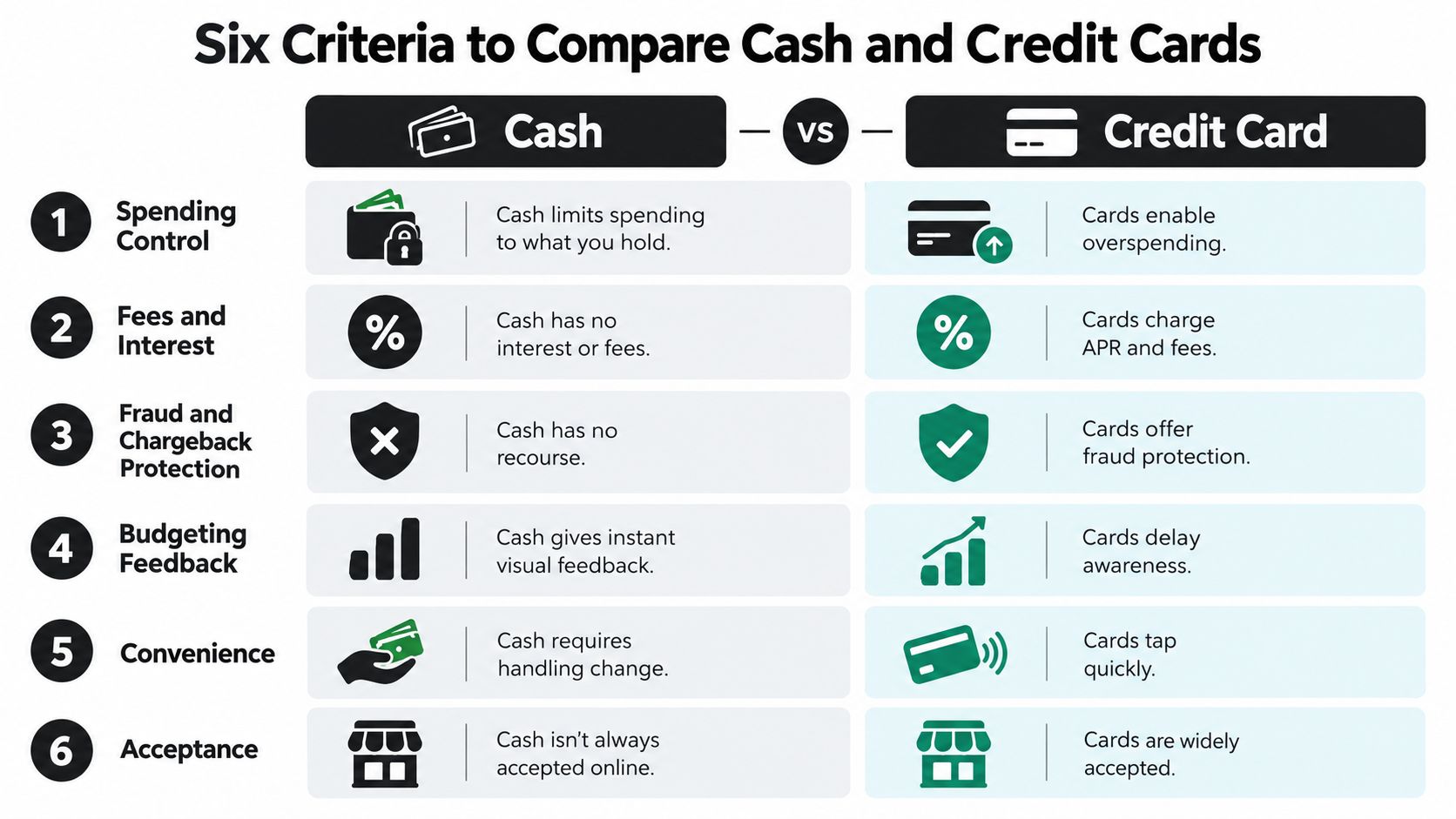
No method wins every row. The right answer depends on whether your priority is behavioral control, low cost, protection, record keeping, convenience, or access. The following decisions become much easier once you identify which criterion matters most for the purchase in front of you.
Spending Psychology When You Swipe vs Hand Over Bills
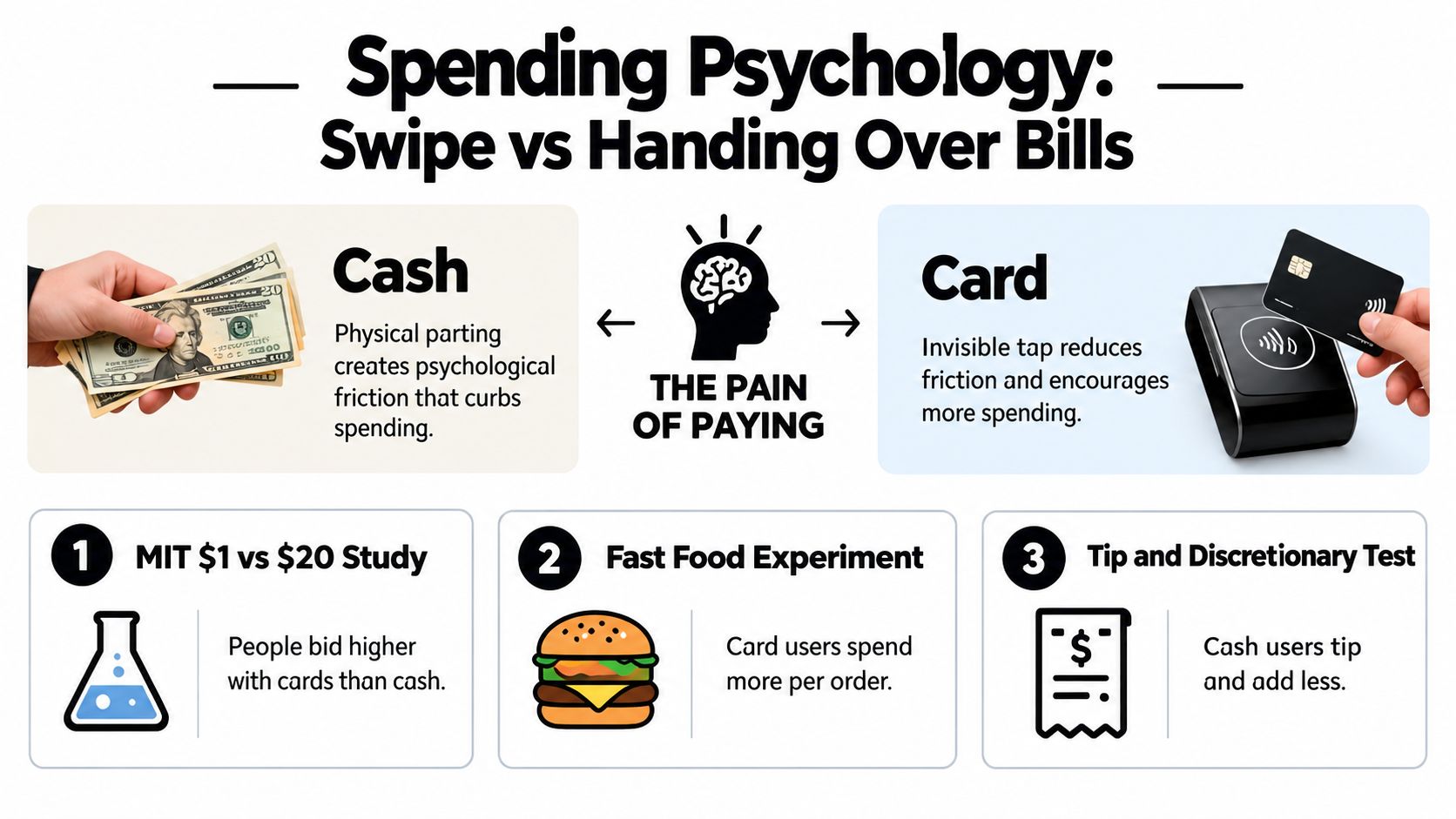
Handing over bills creates a visible parting. Tapping a card compresses the same decision into a nearly invisible motion. That difference can matter when a purchase is optional, emotionally charged, or surrounded by tempting add-ons.
Researchers have used the phrase “pain of paying” to describe the friction people feel when money leaves their possession. You don't need a laboratory to observe the effect. Put a fixed dining budget in an envelope, and the remaining bills tell you whether another meal fits. Put the same budget on a card, and the warning may not arrive until you open the app or statement.
A side-by-side household experiment makes the point without pretending that every person behaves identically. Suppose the same grocery list costs $48 in one checkout and $61 in another because the card user adds impulse items. The difference isn't the card's fee. It's the psychological distance between the choice and the financial consequence.
Three practical tests
- The envelope test: Put the category's full spending allowance in cash. If seeing the remaining bills changes your choices, cash is giving you useful friction.
- The transaction test: Use a card, then categorize the purchase immediately. If instant logging keeps the category accurate, the card may be safe for that type of spending.
- The rewards test: Remove the points from your decision. If you'd still make the purchase without rewards, the card is serving the plan rather than driving it.
Rewards can create a false sense of savings. Earning points on an unplanned purchase doesn't make the purchase budgeted, and it doesn't repair a carried balance. A visible statement can also become stressful when spending has drifted, which is why scary bank statements control spending is a useful discussion of how financial visibility can affect behavior.
Cash isn't automatically disciplined, either. Some people withdraw extra money and treat it as permission to spend. Others find cards easier for groceries because transaction records expose patterns. Use this spending-tracking guide to test your own behavior rather than adopting someone else's payment rule.
Fees, Interest, Fraud, and Chargebacks in Real Numbers
The cheapest payment method depends on what happens after the purchase. Cash can avoid interest, but accessing it may involve an ATM fee and losing it offers no recovery path. A credit card can cost nothing beyond the purchase when the balance is paid in full, but carrying debt changes the calculation quickly.
Use your own account terms for exact fees and dispute rules. For a worked example, the assigned figures below show why payment discipline matters:
| Cost Factor | Card User Who Pays in Full | Card User Who Carries a Balance | Cash User |
|---|---|---|---|
| Interest | $0 when the statement balance is paid in full | A $1,500 balance at 22% APR, cleared over 14 months, costs about $256 in interest under the stated example | No card interest |
| Access cost | No required cash withdrawal | No required cash withdrawal, but debt adds interest | An average $4.97 ATM surcharge can apply |
| Four monthly ATM trips | Not applicable | Not applicable | About $240 per year in the stated withdrawal pattern |
| Rewards | May earn rewards under the card's terms | Rewards may be outweighed by interest | No card rewards |
| Unauthorized transaction recovery | Card protections and issuer dispute process may apply | Same protections, subject to issuer rules | No comparable chargeback process |
| Best use | Planned purchases with immediate repayment | Avoid unless a payoff plan is certain | Categories needing hard spending limits |
The Fair Credit Billing Act limits liability for unauthorized credit card use to $50, and many issuers reduce that liability to $0 under their policies. Card disputes also create a process for eligible billing errors or merchant problems, although the exact notice requirements and dispute windows depend on the transaction and issuer.
Cash has a different risk profile. If you lose a withdrawal or hand over money for a purchase that goes wrong, you generally don't have the same documented reversal process. That certainty can be worth more than rewards for expensive or complicated purchases.
Business owners also need to separate personal budgeting from tax treatment. Anyone asking can you deduct business credit card interest should review the facts with a qualified tax professional rather than assume every interest charge qualifies.
The practical comparison is simple. Pay the card in full, and it can be a low-cost protection and record-keeping tool. Carry a balance, and interest becomes the central cost. Use cash, and you trade protection for control and payment certainty. Your budget app bank sync can help you see the account activity, but it can't make an unaffordable balance affordable.
Zero-Based Budgeting With Cash, Cards, or Both
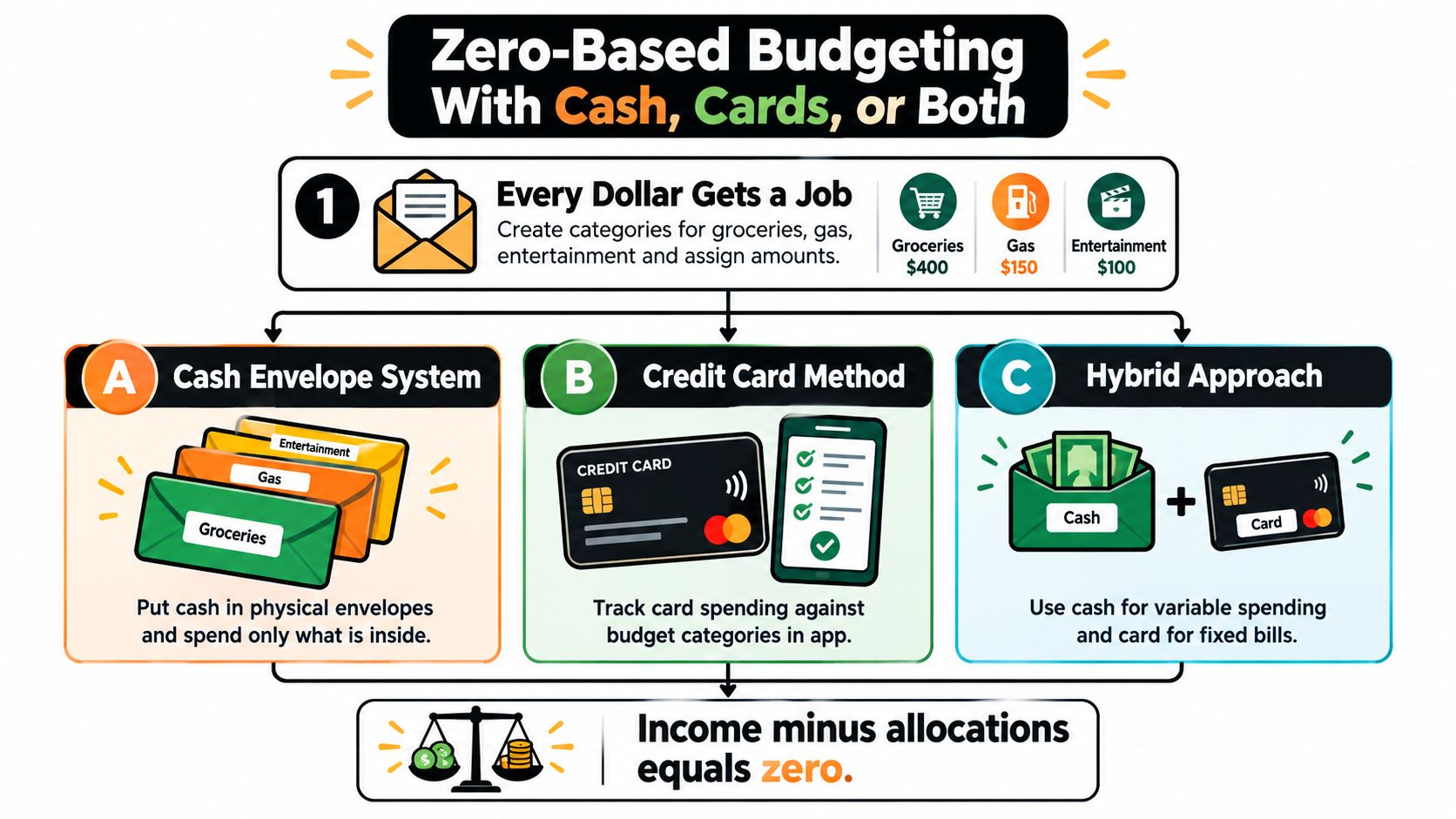
Zero-based budgeting means assigning every dollar of expected income before the month unfolds. The payment method determines how reliably you can compare that assignment with what leaves your accounts.
A physical envelope system works best for variable categories. Create envelopes for groceries, gas, dining, and entertainment, then place each category's assigned cash inside. When the envelope is empty, spending stops or another category must explicitly give up money. That makes the budget visible, but cash won't handle every obligation, especially online bills and merchants that require electronic payment. A practical guide to cash envelopes for budgeting can help you set up the categories without turning the system into a burden.
The card method replaces physical envelopes with digital assignments. Before charging a purchase, check the category's available amount. After charging it, record the transaction and reserve the matching money for the card payment. This system works only if the statement balance is paid in full and the budget reflects purchases promptly.
A $5,000 income example
| Setup | Allocation Approach | Reconciliation Work | Main Overspend Risk |
|---|---|---|---|
| Envelope-only | Assign the full $5,000 across physical categories and non-cash obligations | Count remaining cash and update the ledger | Cash handling gaps and categories that cannot accept cash |
| Card-only | Assign the full $5,000 digitally, then match every charge to a category | Review transactions and reserve cash for the statement | Delayed awareness and carried balances |
| Hybrid | Assign the full $5,000, using cash for vulnerable flexible categories and cards for fixed or online expenses | Reconcile both physical cash and electronic activity | Forgetting to record one side of the system |
The hybrid setup is the strongest default for many households. Use cash for the categories where you repeatedly buy extras. Use a card for fixed bills, online purchases, and expenses where transaction records or dispute options matter. Debit can cover purchases that need account-level control without creating revolving card debt.
The rule is that the budget, not the payment method, owns the money. If you move $40 from dining to groceries, record the transfer before spending it. If a cash purchase replaces a card purchase, update the same category immediately. Zero-based budgeting fails when money changes jobs without a record.
Which Payment Method Fits Your Money Goals
Your payment method should match the behavior you're trying to reinforce. A debt-payoff client doesn't need more payment flexibility. They need a clear boundary around discretionary spending and a system that prevents new balances.
| Profile | Primary Method | Secondary Method | Budgeting Behavior | Watch For |
|---|---|---|---|---|
| Debt-payoff client | Cash envelopes for vulnerable categories | Debit for planned essentials | Fund categories before spending and stop when the cash is gone | Replacing cash limits with a new credit balance |
| Rewards optimizer | One flat-rate credit card | Checking account for repayment | Categorize purchases promptly and reserve the full statement amount | Spending more to earn rewards |
| Irregular-income freelancer | Cash for variable personal spending | Card for essentials and online purchases | Budget from confirmed income and keep flexible categories visible | Treating available credit as available income |
The debt-payoff client
Choose cash for groceries, dining, entertainment, or any category where card spending has produced unplanned purchases. Use debit for necessary purchases that need a transaction record. The objective isn't to avoid every card forever. It's to restore a pattern where spending follows available money.
The rewards optimizer
A single credit card can be efficient when you pay the statement balance in full every month. Don't carry a balance to preserve rewards, and don't add purchases merely to reach a promotional threshold. The card wins here because protection, convenience, and rewards support a budget that already works.
The irregular-income freelancer
Separate predictable obligations from flexible spending. A card can provide useful records for business-related or online purchases, while cash can keep personal variable spending from outrunning an uneven income month. Reconcile the accounts whenever income arrives, rather than assuming a high credit limit represents money you have earned.
Decision rule: If card payments lead to carried balances or unplanned purchases, move discretionary categories to cash until the pattern reverses. If you pay in full and want rewards, a suitable credit card wins. If you need guaranteed feedback with no easy override, cash wins.
Quick Answers About Mixing Cash and Credit
Can I pay off a credit card with cash from my checking account?
Yes. The issuer cares that the payment reaches the account by the statement due date, whether you use a bank transfer or another accepted payment method. The money should already be assigned in your budget, as discussed in the zero-based budgeting section.
Should I use cash and credit cards at the same time?
Yes, if each method has a defined job. Cash can fund groceries and dining where control matters, while cards can handle fixed bills and online purchases where records and dispute processes are useful.
What if a vendor accepts only cash?
Withdraw the amount from checking and log it against the matching budget line that day. That keeps the zero-based totals accurate and prevents a cash withdrawal from becoming an invisible spending category.
The best cash vs credit card system is not the one that looks most advanced. It's the one that makes your next decision obvious, protects assigned money, and helps you finish the month without a surprise balance.
Peaceful Mindful Pocket LLC offers a zero-based budgeting app that assigns every dollar to categories, imports transactions through secure bank connections, and supports tracking across checking and credit card accounts. Visit Peaceful Mindful Pocket LLC to start with a demo budget and test a clearer cash-and-card system with the seven-day free trial.