A practical U.S. household should plan on $75 to $90 per month for internet, before equipment rentals and taxes. If you only look at the advertised rate, you'll guess wrong.
The average internet bill per month is not one clean number. It shifts with speed, connection type, data policy, and where you live, so the right budget number has to match the service you'll keep.
Table of Contents
- What Most People Pay for Internet Each Month
- How Connection Type and Speed Change Your Bill
- Hidden Charges That Raise Your Actual Monthly Cost
- Internet Costs by Household Type and Real Use Case
- Budgeting for Internet Using Zero Based Principles
- Practical Ways to Lower Your Monthly Internet Bill
What Most People Pay for Internet Each Month
Most households should start with a $62 to $75 anchor, not a fantasy national average. A separate U.S. benchmark puts a 100 Mbps connection at about $62 per month, while another practical household estimate lands near $75 per month for internet only, before add-ons. Popular plan data also sits in that same neighborhood, with mainstream plans around $69.33 and high-speed plans around $97.34. NerdWallet's internet cost overview
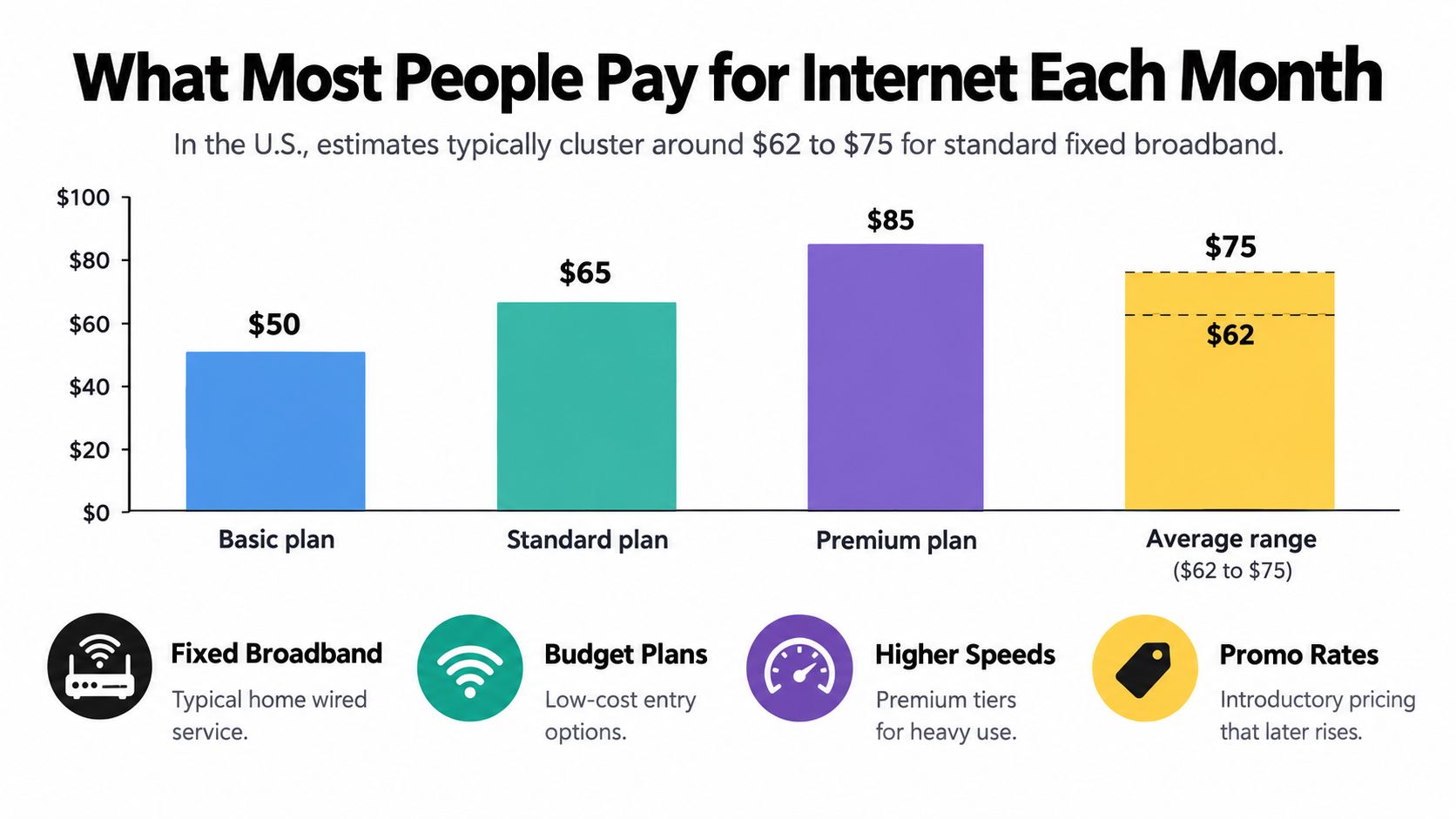
That's the range to use for ordinary fixed broadband, not for every household. A rural home with limited provider choice can face a very different reality, and satellite service can average about $110 per month because there may not be a cheaper local option.
Use the right benchmark for your home
Practical rule: if you stream, work from home, or have multiple devices online at once, budget above the lowest advertised price and stay closer to the middle of the range.
A lot of people get tripped up because they compare their bill to a single average that hides trade-offs. A low-cost entry plan, a standard family plan, and a premium speed tier are not interchangeable, even if they all show up under the same “internet” label.
If you think of broadband as a fixed household expense, it gets easier to budget. Fixed expenses are recurring obligations, and internet belongs in that same bucket as soon as you rely on it for work, school, or daily life.
For households comparing wireless options, $50 to $60 5G home internet can be a useful reference point, but only if the plan fits your speed and data needs. The right monthly number is the one that matches your usage, not the one with the flashiest promo.
How Connection Type and Speed Change Your Bill
Your connection type can change the monthly bill more than a national average suggests. The FCC's 2024 Urban Rate Survey collected 13,332 monthly internet rates, ranging from $11.40 to $1,000.00. Its internet-only weighted means ranged from $51.28 for fixed wireless to $160.34 for fiber. The FCC also cites research showing that households earning below $50,000 annually paid an average of $66.53 per month for home broadband. FCC 2024 Urban Rate Survey
Technology sets the floor
Copper or DSL, cable, fixed wireless, and fiber serve different needs, so their prices are not interchangeable. Fiber often costs more because it provides greater capacity and stronger performance. Fixed wireless can reduce the bill when your household has lighter usage and local availability is good. Rural households may still pay more if provider choice is limited.
Choose the technology first, then compare speed and data rules within that category. This prevents a low advertised rate from becoming your benchmark when the plan cannot support your household.
Speed and allowance move the bill upward
Consumer Reports found that unlimited data could add as much as $49.99 per month, while upgrading to about 300 Mbps could add about $20 per month. Consumer Reports broadband bill analysis
Compare the whole plan, not just the headline rate.
A lower-speed plan may work for basic browsing and occasional streaming. Multiple video calls, cloud backups, gaming downloads, and constant streaming justify a higher tier or more generous data allowance. Budget for those requirements directly, rather than choosing the cheapest plan and paying later for upgrades or overages. The right bill matches your household's actual demand, technology options, and data policy.
Hidden Charges That Raise Your Actual Monthly Cost
The advertised rate rarely matches the amount leaving your account. Recurring fees, equipment charges, and expired promotions can turn a manageable plan into a costly monthly commitment.
Check the recurring fees first
Start with the charges that appear every month. Installation may be a one-time cost, while equipment rental, service fees, and other provider charges continue long after setup. Review the bill before comparing plans, because the base price alone cannot show your actual budget requirement.
Check these fields:
- Monthly price, before optional extras.
- Mandatory fees, including recurring service charges.
- Typical speeds, rather than the peak number in the advertisement.
- Data policy, including the cost of unlimited use.
- Equipment charges, especially modem or router rental.
A lower advertised rate can still cost more when the provider adds required fees or charges for equipment you could supply yourself. Compare the recurring total at the speed and data allowance your household needs.
Watch for post-promo pricing
Promotional rates help only when you know their expiration terms. After the introductory period ends, the monthly charge may rise sharply. Record the regular price before signing up, and use that figure in your household budget from the beginning.
Best habit: compare the total recurring price, required speed, and data policy. Treat the teaser rate as temporary unless the provider confirms the long-term charge.
Reliability also affects cost. Repeated outages can waste work time, disrupt school, and lead to support calls. Use SMB internet outage solutions to review practical troubleshooting steps before paying for a faster plan that may not solve the underlying problem.
Track the internet charge in a bill-tracking app alongside other recurring subscriptions. Review the amount after promotions end and whenever the provider changes fees. Your budget should reflect the bill you will receive, not the price shown in the advertisement.
Internet Costs by Household Type and Real Use Case
A single-person apartment doesn't need the same plan as a house full of streamers and remote workers. The mistake is treating those households as if they should all pay the same average, when their usage patterns are completely different.

Match the bill to the household
A single-person household that mostly browses and streams lightly can usually stay near the lower end of the ordinary range. A family streaming simultaneously, or a home with multiple video calls and large downloads, should expect to land in the middle or upper part of the range because the plan has to carry more load.
Rural households need a different lens. Satellite can average about $110 per month, and in some places it's the only realistic option, so telling those families to “shop around” is not helpful advice.
The International Telecommunication Union shows why affordability can't be judged by price alone. Global internet affordability is commonly measured as a share of income, not one universal dollar amount, and the ITU reported that the global median fixed-broadband basket fell from 2.8% of gross national income per capita in 2023 to 2.5% in 2024, while the mobile-broadband basket declined from 1.3% to 1.1%. ITU affordability report
Income changes the burden
Broadband affordability is highly unequal, and average monthly broadband spending can represent about 4.2% of expenditure for the lowest-earning households versus 0.6% for the highest-earning households. That gap is why one family may treat internet as a manageable utility while another feels squeezed by the same bill.
If your household income is tight, the right question isn't “what's average?”, it's “what bill still leaves room for food, rent, and transport?”
Remote workers and gamers should also budget differently from casual users. Their plan has to hold up under sustained use, so the cheapest option often turns into the most frustrating one.
Budgeting for Internet Using Zero Based Principles
A zero-based budget works because every dollar gets assigned a job before the month starts. That's the right way to handle internet, since it's a recurring essential with predictable ups and downs.
Build the line item in two parts
Put the base internet bill in your budget first. Then add a separate cushion for equipment rental, taxes, data-cap risk, and any post-promotional increase.
A more resilient planning ceiling is about $90 per month, even though the median sits closer to $75. That extra room keeps a surprise fee from blowing up the rest of the month.
Use actual statements, not guesses
Each month, replace your estimate with the provider statement. That one habit keeps the budget honest, because internet charges change when the promo ends, the plan changes, or the provider adds a fee.
Plan it once, update it monthly, and stop letting the bill decide the budget for you.
Peaceful Mindful Pocket LLC is built for that kind of recurring-expense tracking. Its zero-based budgeting setup helps users assign a plan amount to internet, then compare the plan to the actual charge with secure, read-only bank connections and encrypted data handling.
If you want a practical example of how to structure that kind of budget, this zero-based budgeting example shows the approach in a simple format. The key is not perfection, it's consistency.
Practical Ways to Lower Your Monthly Internet Bill
A 100 Mbps connection was estimated at about $62 per month in the U.S. in 2024, but observed prices ranged from $20 to nearly $300. That spread makes a single national average a weak budgeting target. Compare the total charge for your household's actual speed, connection type, equipment, and location. Installation, rental fees, taxes, and other charges can push the final bill higher. Broadband affordability brief
Cut the avoidable costs
Start with the provider's full monthly amount, including taxes and mandatory fees. A low promotional rate can become expensive after the offer ends, so record the expiration date and compare alternatives before the change appears on your statement.
Buy a compatible router when the rental fee will cost more than the equipment over time. Ask whether your plan includes data limits, installation charges, or other recurring add-ons. If your household uses modest speeds, downgrade instead of paying for capacity you do not use.
Check whether current assistance applies to your household. The end of the U.S. Affordable Connectivity Program removed $30 to $75 per month in support for roughly 23 million low-income households, as detailed in the brief cited above.
- Compare the same speed tier: match speed and connection type before judging the price.
- Own hardware when the payback works: remove a repeating rental charge once the savings exceed the equipment cost.
- Review each statement: catch expired promotions, overages, and add-ons promptly.
If the bill still strains your budget, call the provider and request a lower-cost plan, renegotiate the terms, or compare another provider. The average internet bill per month offers context, not a target. Budget for the charge your household will receive.
Peaceful Mindful Pocket LLC helps households assign every dollar a job and track recurring bills. Visit Peaceful Mindful Pocket LLC to review its zero-based budgeting approach.