
Your paycheck notification arrives, and before you pay rent, refill the car, or order dinner, your mind starts sorting the money. Some of it already belongs to the household. Some needs to protect your future. The rest should let you enjoy the month without guilt.
The 60 20 20 rule gives those decisions three clear homes. It uses take-home pay, not gross income, and guides about 60% toward needs, 20% toward savings or debt reduction, and 20% toward wants. Personal-finance explainers describe it as a modern percentage-based budgeting variation that can be adjusted as household costs change, especially when fixed expenses take a large share of income. Clever Girl Finance explains the 60/20/20 framework and First Citizens compares percentage-based budgeting methods.
The percentages are a starting point, not a test you can fail. The useful part is turning those broad buckets into actual line items, then giving every dollar a job through a zero-based budget.
Table of Contents
- What the 60 20 20 Rule Looks Like in Real Life
- The Three Buckets Explained
- How 60 20 20 Compares to Other Budget Splits
- Steady Paycheck vs Irregular Income Examples
- Setting It Up Inside a Zero-Based Budget
- Where People Get the Rule Wrong
- Your First 30 Days With the 60 20 20 Rule
What the 60 20 20 Rule Looks Like in Real Life
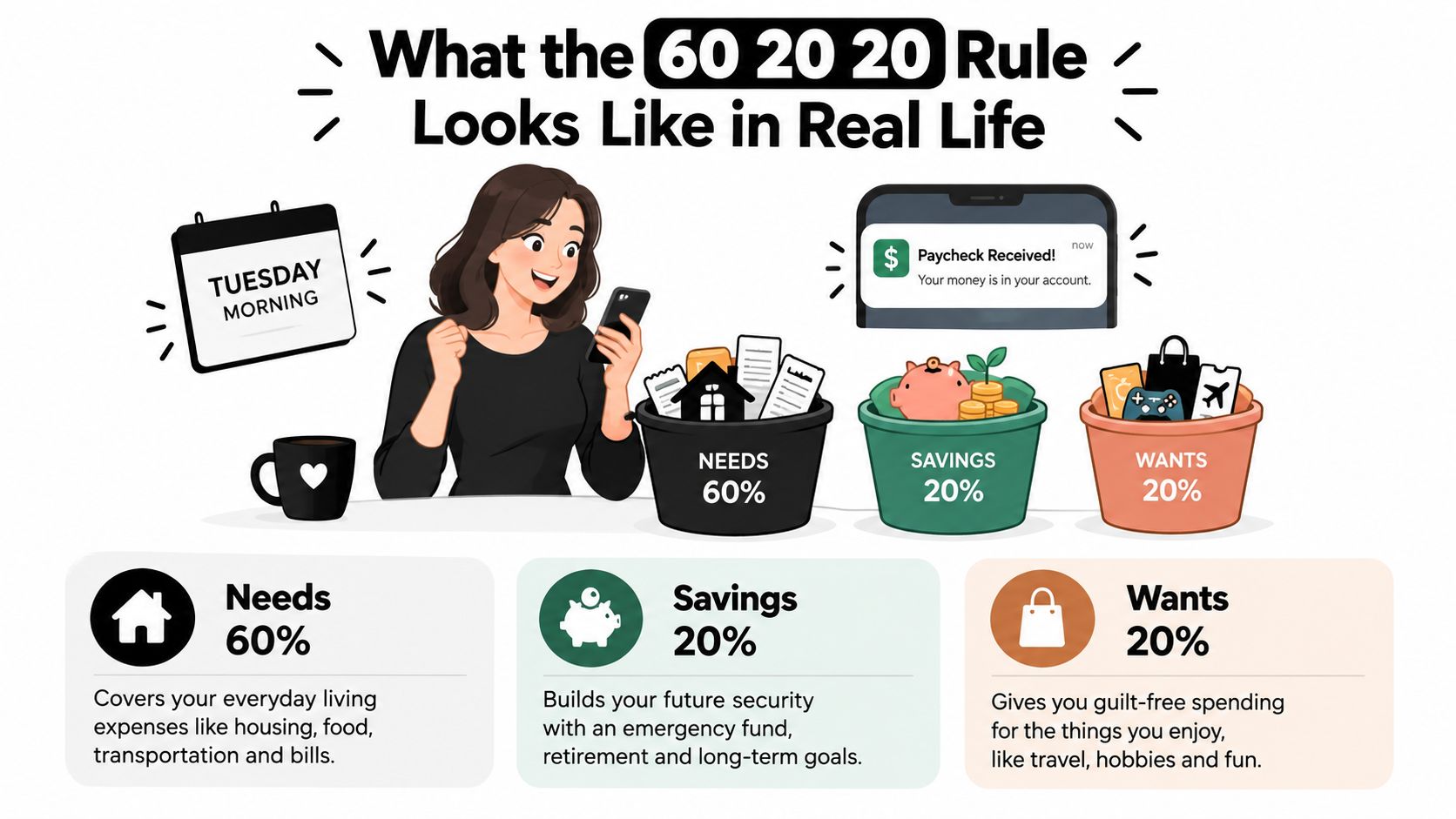
It's Tuesday morning. Your phone buzzes with a paycheck notification, and you open your banking app before the coffee has finished brewing. You already know three piles are waiting for that deposit.
The first pile covers everyday life, including housing, food, transportation, and bills. The second protects what comes next, such as emergency savings, retirement, or debt goals. The third pays for the parts of life that aren't essential but still matter, including meals out, hobbies, and small treats.
For a household bringing home $4,000 per month, the framework assigns $2,400 to needs, $800 to savings or debt reduction, and $800 to wants. You don't need complicated software to see the shape of the plan. You need a take-home amount and three destinations.
Start with the deposit you can actually use
The rule normally applies to monthly net pay, meaning the money that reaches your checking account after taxes and other payroll deductions. That distinction matters because a plan based on gross pay can make every category look larger than the money available for bills.
Practical rule: Budget from the amount that lands in your account, not the salary figure printed before deductions.
After setting the three broad limits, translate each one into real categories. The needs pile might contain rent, groceries, utilities, and minimum payments. The savings pile might contain an emergency fund and retirement contribution. The wants pile might contain streaming, restaurants, and weekend activities.
If your real spending doesn't fit perfectly, adjust the plan instead of abandoning it. A household with high housing costs may need a larger needs share for a period, while a household with lower fixed expenses may direct more toward goals. The framework gives you a clear comparison point, then your actual life supplies the details.
The Three Buckets Explained
The needs bucket pays for obligations and essentials you must cover to keep the household running. Rent or a mortgage, utilities, groceries, insurance premiums, minimum debt payments, transportation, and childcare usually belong here.
The savings bucket handles money that improves your future position. That includes emergency savings, retirement contributions, extra debt payments above the minimum, and sinking funds for predictable costs such as car repairs or annual subscriptions. A sinking fund prevents a known future bill from becoming a surprise.
The wants bucket pays for flexible enjoyment. Dining out, streaming services, hobbies, weekend trips, and a new phone case can fit here. Wants aren't bad spending. They become a problem when they displace bills or savings.
Recalculate the split from your own pay
Suppose your household takes home $3,500 per month. Multiply that income by each target percentage, then compare the result with your planned categories. A spending-category guide such as this household budgeting categories resource can help you decide where less obvious purchases belong.
| Bucket | Percentage | Dollar Amount | Sample Categories |
|---|---|---|---|
| Needs | 60% | $2,100 | Rent, groceries, utilities, transportation, insurance, minimum debt payments |
| Savings or debt reduction | 20% | $700 | Emergency fund, retirement, extra debt payments, sinking funds |
| Wants | 20% | $700 | Dining out, streaming, hobbies, trips, personal purchases |
The table isn't asking you to label every purchase perfectly. Start with the reason for the expense. If you must pay it to maintain housing, transportation, health, or work, it likely belongs in needs. If it strengthens your financial position later, it belongs in savings. If you can pause it without creating a household problem, it probably belongs in wants.
Some categories need a judgment call. A phone plan may support work and family communication, but an upgraded device or premium add-on may be a want. Write the decision into your budget so you apply it consistently next month.
How 60 20 20 Compares to Other Budget Splits
Percentage systems use different tradeoffs. The familiar 50/30/20 split gives needs half of take-home pay, wants nearly a third, and savings the remaining share. The 60/20/20 rule reduces the wants allowance and gives that additional room to savings or debt reduction.
Other households use a 70/20/10 approach when essential costs take more space, or an 80/20 framework when they want a simpler structure with a broad spending category and a savings target. These aren't competing laws. They're different ways to create boundaries around money.
| Split | Needs | Savings | Wants | Best For |
|---|---|---|---|---|
| 60/20/20 | 60% | 20% | 20% | Households balancing elevated fixed costs with meaningful saving |
| 50/30/20 | 50% | 20% | 30% | Households whose essential costs fit comfortably within a smaller share |
| 70/20/10 | 70% | 20% | 10% | Periods when needs are high and discretionary spending must tighten |
The 60/20/20 version may fit a household in an aggressive savings phase, or one living where housing, transportation, and insurance consume a large part of income. Its needs target is more forgiving than the classic split, while its savings target remains visible.
You should also know when to set it aside. If needs already consume most of the household's income, forcing an arbitrary target can create frustration rather than clarity. A low-income household may need a survival-focused plan, while someone in an intense debt payoff phase may direct more than the usual savings allocation toward debt.
A household with unusually low fixed costs may responsibly choose more wants, provided it continues saving and meeting obligations. The right split is the one that reflects your priorities and remains usable month after month.
Steady Paycheck vs Irregular Income Examples
Maria is a salaried nurse who brings home $4,200 each month. Her needs target is $2,520, so she assigns that amount across the household's required line items before planning flexible spending.
Her savings target is $840. She sends $400 to an emergency fund, $300 to a Roth IRA, and $140 to a December gift fund. Her wants target is also $840, divided into $300 for dining out, $280 for streaming and hobbies, $200 for travel, and $60 for coffee.
| Line Item | Maria, Salary $4,200 | Devon, Freelance $6,000 |
|---|---|---|
| Income received | $4,200 | $6,000 across three deposits |
| Planned needs | $2,520 | $2,280 baseline from $3,800 pay |
| Planned savings or debt reduction | $840 | $760 baseline from $3,800 pay |
| Planned wants | $840 | $760 baseline from $3,800 pay |
| Extra income handling | Not applicable | $2,200 moved to a buffer account |
Maria can assign her money at the beginning of the month because her income is predictable. She still reviews the plan, but the timing of her deposits doesn't require a separate cash-flow system.
Devon, a freelance designer, earned $6,000, but the money arrived in three uneven deposits. Instead of treating every deposit as permission to spend, he pays himself a baseline monthly amount of $3,800 on the first day of the month. He assigns that amount across the same three buckets, then places the remaining $2,200 into a buffer account.
Let the timing flex without changing the structure
Devon can top up savings or wants at the end of the period after he knows what he earned and what the business needs. He doesn't build rent or groceries around expected client payments.
For a deeper walkthrough of cash-flow planning, see this guide to budgeting with irregular income. The central idea is simple: the buckets stay consistent, while the timing changes.
If income arrives late, fund needs first. If income exceeds the baseline, protect the extra until upcoming obligations are covered. This approach keeps a strong month from creating an expensive lifestyle commitment that a slower month can't support.
Setting It Up Inside a Zero-Based Budget
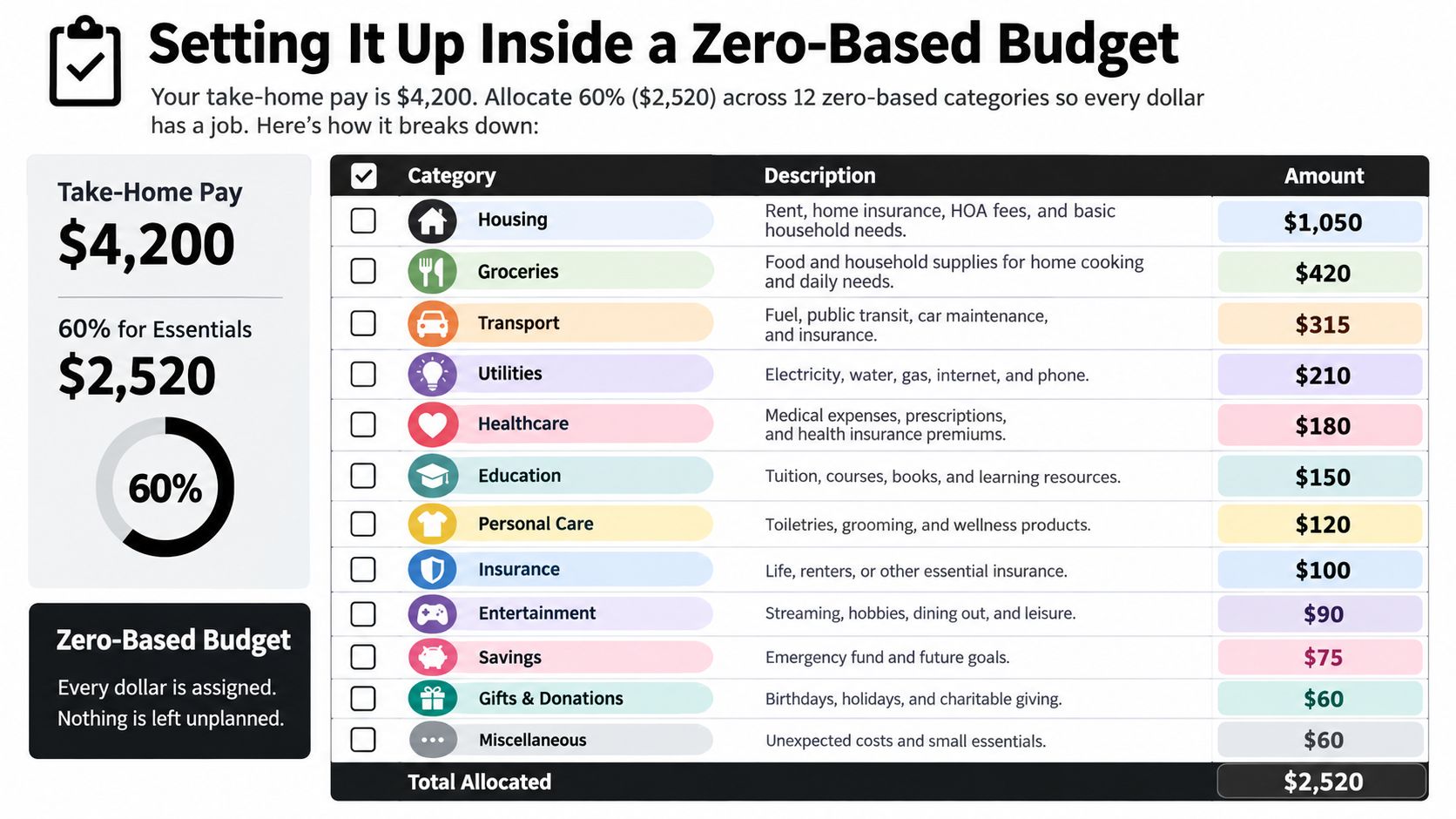
The percentage rule gives you boundaries. A zero-based budget turns those boundaries into individual assignments, so income minus every planned line item equals zero.
Start with the needs amount from Maria's example, $2,520, and break it into categories. The following assignment uses every dollar of that needs bucket.
| Needs Category | Assigned Amount |
|---|---|
| Rent | $1,150 |
| Groceries | $420 |
| Car and insurance | $310 |
| Utilities and phone | $260 |
| Student loan minimum | $180 |
| Gas and transit | $180 |
| Renter insurance | $20 |
| Electricity reserve | $0 |
| Internet reserve | $0 |
| Medical copay reserve | $0 |
| Annual bill reserve | $0 |
| Household essentials reserve | $0 |
| Total assigned | $2,520 |
The zero entries show an important point. A category doesn't need funding in every month to have a place in the plan. You can assign money to less frequent bills when they arise, then protect the category from being forgotten.
Give savings a name
The savings allocation becomes easier to protect when it isn't one vague line. Name separate destinations such as:
- Emergency fund: Money for unexpected essential costs.
- Retirement: Contributions for long-term financial security.
- Sinking fund: Planned annual or irregular expenses.
- Goal fund: A defined objective, such as education or a move.
For a household preparing to move into its first home, Divvy's first apartment budgeting guide offers another useful reminder: housing costs extend beyond the rent amount, so line-item planning matters.
A budgeting app can make this process easier by importing transactions and letting you categorize them against the plan. Peaceful Mindful Pocket LLC offers a zero-based budgeting app with an auto-generated demo budget, editable buckets, income sources, planned amounts, read-only bank connections, and transaction imports. You can also review how to create a budget before building your categories.
Use a repeatable setup routine
Set up the framework in this order:
- Create one master group: Label it 60 20 20.
- Build three parent buckets: Use Needs, Savings or Debt Reduction, and Wants.
- Add child categories: Place rent, groceries, retirement, dining, and other line items under the appropriate parent.
- Set target percentages: Use the intended bucket proportions as your starting targets.
- Link checking: Connect the account where income and regular spending appear.
- Turn on rollover: Let unused savings allocations remain available for their future purpose.
- Schedule a Sunday review: Spend a short, consistent period checking transactions and adjusting assignments.
On payday, assign expected take-home pay across the three parents, then distribute each parent into its child categories. The rule tells you how much each bucket can hold. Zero-based budgeting tells you exactly where that money will go.
Where People Get the Rule Wrong
The math is easy. The classification is where many budgets break.
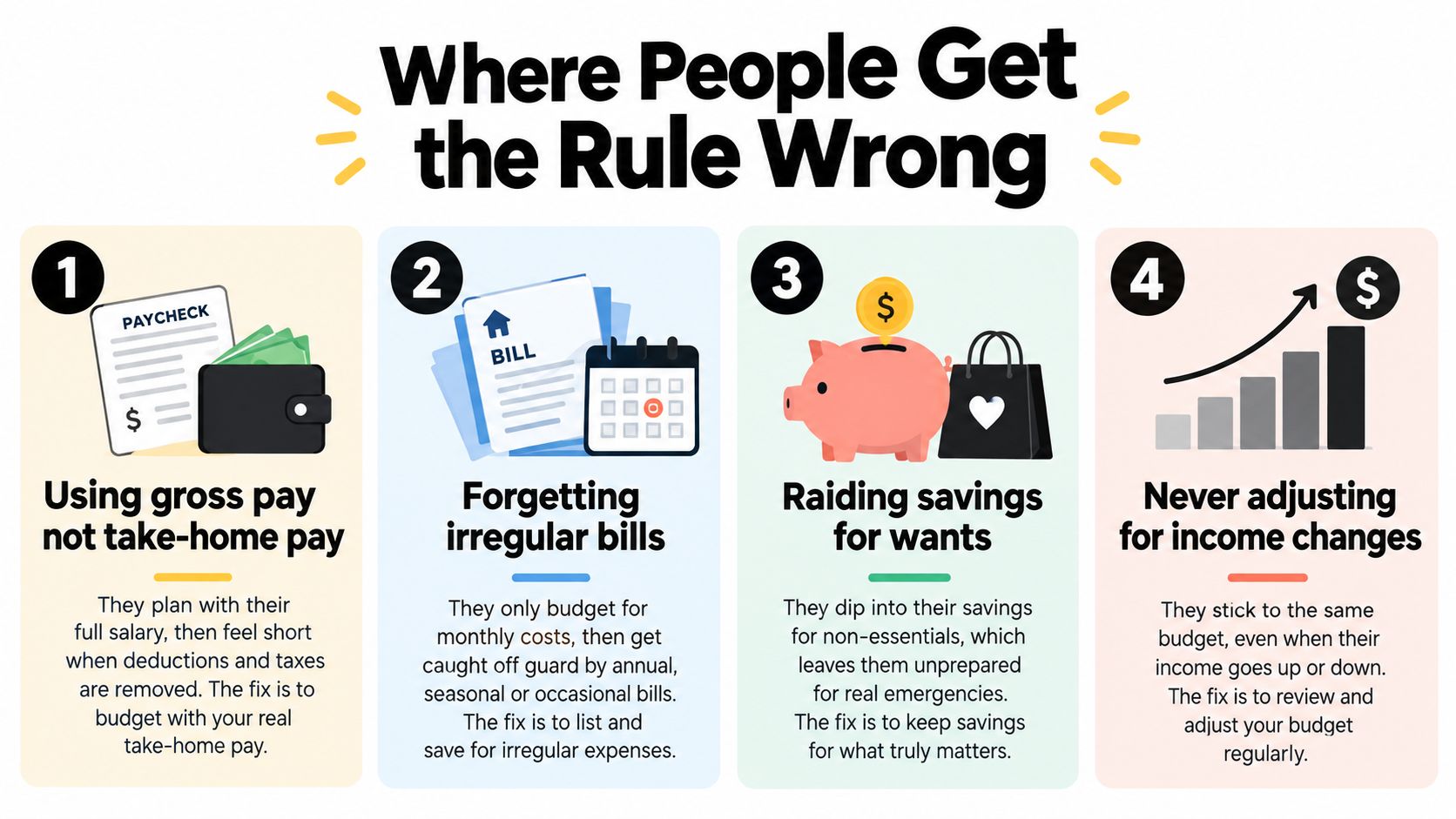
Four traps to remove early
- Using gross pay: Start with the deposit that reaches checking. Gross income includes money you can't spend, so it inflates every target.
- Hiding debt in wants: Minimum debt payments belong with needs because they're required obligations. Extra payments above the minimum belong with savings or debt reduction.
- Treating subscriptions as harmless: Auto-renewing services can turn flexible wants into a fixed monthly burden. Review, cancel, or consolidate them regularly.
- Skipping savings completely: A tight month may require reducing wants, but abandoning the savings bucket removes the habit the framework is meant to protect.
Credit card spending can create another blind spot. The purchase belongs to the category that explains it, while the repayment must be planned so the household doesn't count the same money twice or rely on future income.
A useful correction: When the month gets tight, reduce flexible spending before you erase your entire future plan.
The rule also needs adjustment when income changes. A freelancer shouldn't calculate the buckets from an optimistic invoice total that hasn't arrived. Use available take-home money or a conservative baseline, then revise assignments when payment clears.
Don't force a perfect ratio when essential bills exceed the target. Record the actual need, identify the pressure point, and decide which flexible category or financial goal will absorb the difference. A budget becomes useful when it tells the truth.
Your First 30 Days With the 60 20 20 Rule
Start with evidence from your own spending. Pull last month's statements and tag each transaction as a need, saving, or want. Don't change the labels to make the ratio look better. Your first job is to discover the starting point.
During the first week, create the three buckets and assign the next income deposit. During weeks two and three, track spending as it happens. A quick Friday check can catch a wants overage before it pulls money away from groceries, transportation, or another required category.
At month-end, compare the planned split with the actual amounts. If wants have money left over, move the surplus into savings or a named goal. If needs ran high, identify the specific line item rather than blaming the whole system.
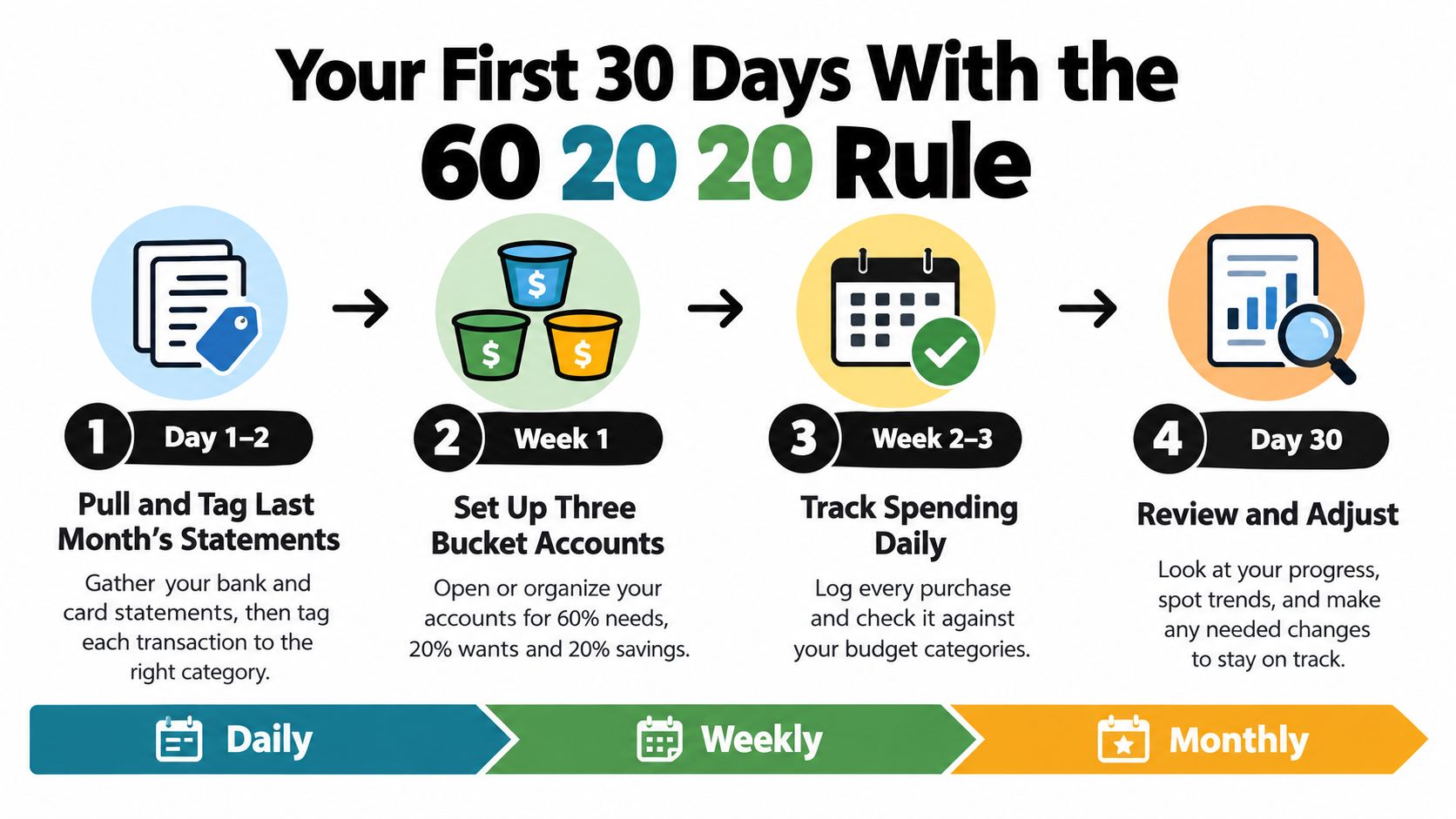
Put one recurring review on your calendar and use it as the anchor for the routine. The plan doesn't need to be perfect on the first attempt. It needs to be visible, honest, and easy enough to update when real life changes.
Peaceful Mindful Pocket LLC offers a zero-based budgeting app that helps you organize the 60 20 20 rule into named categories, import transactions, and give every dollar a job. Visit Peaceful Mindful Pocket LLC to explore the guided budget setup and start building your first three-bucket plan.